Birthday Gifts
Chinese birthday gift for the occasion — birthday Chinese calligraphy gift characters for the year ahead.
Recommended characters
仁 (Rén) — Benevolence
For a milestone birthday when the gift should name a quality already demonstrated rather than a wish for what’s ahead. 仁 is the retrospective choice: not health or longevity or fortune, but the recognition that this person has been consistently oriented toward the people around them. Most appropriate when the recipient is a grandparent, parent, or mentor whose way of treating others has been the long example.
乐 (Lè) — Joy
For a birthday when the gift should name the texture of the year rather than its contents. 乐 does not wish for particular outcomes — it wishes for the felt quality of daily life to be genuinely glad. Most apt for a close friend or companion, at a milestone when the relationship is close enough to make this kind of specific, inward wish rather than an outward one.
美 (Měi) — Beauty
For a birthday that marks real accumulation. 美 does not wish for a beautiful year ahead — it names what the years behind have already produced. Most apt for a milestone when the recipient’s character and presence have become particular enough to be worth observing clearly, rather than simply celebrated.
长寿 (Cháng Shòu) — Longevity
For the elder’s milestone birthday — the 60th, 70th, 80th — when the gathering is itself an acknowledgment that what matters most is more years together. 长寿 is the most direct of the longevity birthday wishes: not the quality of the years (that is 安康 or 康宁), but the years themselves, unspecified and continuing.
康宁 (Kāng Níng) — Health and Ease
For the elder’s birthday when the gift should name both dimensions of wellbeing. 康宁 — the third of the Five Blessings in the Book of Documents — wishes for health in body (康) and settled calm in mind (宁). Distinguished from 长寿 (which asks for more years) and 安康 (which adds safety), it is the wish for the quality of the years: active, healthy, and undisturbed.
平安喜乐 (Píng Ān Xǐ Lè) — Peace · Safety · Joy · Gladness
For a birthday when the gift should name the felt quality of the year rather than a list of outcomes. 平安喜乐 asks that the year ahead keeps the recipient safe and undisturbed (平安) and that it holds genuine gladness (喜乐) — two conditions that make a year worth having, distinct from prosperity or achievement. Most apt for a milestone birthday when the relationship is close enough to wish for experience rather than fortune.
雅 (Yǎ) — Elegance
For the birthday when the gift should name a cultivated quality rather than wish for outcomes. 雅 is not prospective — it does not wish health or joy or fortune. It recognizes the specific way a person sees and chooses and moves through the world, the sensibility that years of attention have produced. The right choice when the relationship is close enough to make that kind of observation honestly.
贤 (Xián) — Worthy Character
For a milestone birthday when the gift should name what the years have verified rather than wish for outcomes. 贤 names demonstrated worth — the combination of practical competence and moral consistency that only becomes fully visible over time. Most specific for the grandmother, mother, or wife at a milestone old enough to be a genuine reckoning with who she has been.
忠 (Zhōng) — Loyalty
For a birthday when the gift should name a quality of faithfulness the recipient has shown rather than a wish for outcomes. 忠 is the recognition for the husband, close friend, or mentor whose wholehearted orientation toward you has been a quiet fact rather than a declaration. Most specific when the relationship is close enough to observe the difference between availability and genuine faithfulness — and old enough to say so honestly.
明 (Míng) — Clarity
For a birthday when the gift should name the quality of clear-sightedness the recipient has demonstrated rather than wish for a quality they might develop. 明 is the recognition for the friend, colleague, or mentor whose perception of complex situations has consistently been accurate — who has seen what was actually there in conditions where most people were seeing what they wanted to see. Most specific when the relationship is close enough to make this observation honestly.
刚 (Gāng) — Principled Firmness
For a milestone birthday when the gift should name a quality of interior firmness the recipient has demonstrated rather than wishing for outcomes. 刚 is the recognition for the father, husband, or mentor whose position has not been moved over years — by wealth that offered a shortcut, by pressure that offered an excuse, by authority that would have made accommodation easy. Most specific when the relationship is close enough to have observed, across enough circumstances, that the standard has simply been consistent.
坚 (Jiān) — Tenacity
For a milestone birthday when the gift should name a quality of sustained firmness demonstrated across years — not in any single crisis but under the accumulated weight of long commitments. 坚 names the property of not having cracked under what pressed against it over time: the pine and cypress that are last to wither when the cold holds. Most specific for the father, husband, or colleague whose particular quality has been structural rather than occasional — recognized only because the cold held long enough to reveal it.
伟 (Wěi) — Greatness
For a milestone birthday — the 60th, 70th, 80th — when the gift should name stature rather than wish for qualities. 伟 does not wish anything forward; it names what the years have already made undeniable: the combination of character and consequence that becomes fully legible only at that scale of accumulation. For the father, grandfather, or husband whose life has been deeply formative to the people in it, and whose milestone is the occasion to name that directly.
铭 (Míng) — Inscription
For a milestone birthday when the right gift names what the elder has permanently left rather than what they still hold. 铭 does not name a quality of the person — it names the durability of their effect: the lessons and example that have been pressed into the people around them, still present and operative without requiring retrieval. The most specific choice when the relationship is close enough to confirm that the teaching has lasted, and the milestone is the occasion to say so.
祥和 (Xiáng Hé) — Auspiciousness and Harmony
For the elder’s milestone birthday when the gift should name both what the years have offered and what the recipient has brought to them. 祥和 is the complete seasonal blessing at the personal scale: a life in which the world has been favorably disposed (祥) and the household held in sustained accord (和). Where 长寿 names the years themselves and 福寿 names specific blessings, 祥和 names the total quality of a life well met — most apt for the grandparent or elder whose milestone is the occasion to name both the fortune they have received and the warmth they have maintained.
安泰 (Ān Tài) — Peace and Cosmic Right-Order
For a milestone birthday when the gift should name a life that has held at every scale — not just the health (安康), the years (长寿), or the accumulated virtue (德), but the complete double condition: the world in its right order (泰) and the person genuinely settled within it (安). 安泰 is the most encompassing atmospheric blessing for the elder whose milestone is the occasion to name what the decades have produced at both the personal and the cosmic level. Most apt for the grandparent, parent, or honored elder whose long life has navigated both the interior and the exterior and held well in both.
仁爱 (Rén Ài) — Benevolent Love
For the milestone birthday of a parent or grandparent when the gift should name love as practice rather than feeling. 仁爱 names what neither 仁 nor 爱 alone captures: the love that has already shown itself as daily conduct — undemonstrative, sustained, oriented entirely toward the other person’s wellbeing. The right choice when the relationship is close enough to say, with confidence, that this is what has characterized their years with the family.
福乐 (Fú Lè) — Blessing and Joy
For a birthday when the wish should name both the conditions of a good year and the felt quality of living through it. 福乐 is more complete than 乐 alone (gladness without the conditions) and warmer than 福 alone (conditions without naming the experience). Most apt for a friend, close companion, or couple where the birthday is the occasion to give the complete wish — fortune and joy in two characters, neither half left implicit.
忠孝 (Zhōng Xiào) — Loyalty and Filial Piety
For the milestone birthday of a father, grandparent, or mentor whose years have been marked by sustained faithfulness to what they took on. 忠孝 names both the quality of the recipient’s record (忠 — the wholehearted orientation toward commitment and the people depending on them) and the filial recognition the occasion calls for (孝 — the acknowledgment that runs toward those who gave what cannot be fully returned). More encompassing than either character alone and more specific than 德: the complete pair for the elder whose milestone is an occasion for the full classical accounting.
才华 (Cái Huá) — Talent and Brilliance
For the birthday when the gift should name not a quality the recipient is developing but one they already have — and have had for a long time. 才华 is the recognition gift for the colleague, friend, or boss whose work has carried a particular quality that belongs specifically to them: the angle no one else found, the contribution that was recognizable before anyone knew who made it. Not a wish forward, not praise for effort: the acknowledgment, on this birthday, that the talent has been evident and worth naming.
担当 (Dān Dāng) — Taking Responsibility
For the milestone birthday of a father, husband, or boss whose years demonstrate a recognizable pattern: when a situation needed someone and no one had been formally assigned, they were the one. 担当 names the initial act of stepping in — not the sustained faithfulness (忠) or the resolve under difficulty (毅) that followed, but the moment before both: the choice to pick up the load. Among the birthday recognition characters, it is the most specific to this habit of initiative — the person whose reliability has always had this forward-leaning quality.
刚毅 (Gāng Yì) — Firm Resolve
For the milestone birthday of a father, husband, or boss whose record proves something that requires time to see: that both types of interior intactness were present across the same life. 刚毅 names the compound quality that the birthday milestone is the occasion to name — the years have now accumulated enough for the verdict to be clear. Not just principled (刚) or just determined (毅), but both, demonstrated in opposite circumstances. Where 刚 names the interior that held against inducement and 毅 names the determination that held against difficulty, 刚毅 names the person who met both tests — the recognition that only a long enough record makes possible.
坚强 (Jiān Qiáng) — Resilient Strength
For the birthday of a husband or friend whose difficult years have demonstrated 坚强 rather than just either quality separately. 坚强 as a birthday recognition requires knowing the recipient well enough to say that they have been through difficulty and come through it: held structurally without cracking (坚) and kept their capacity to act and move forward (强). Where 乐 wishes for gladness ahead and 刚毅 names the compound interior intactness, 坚强 names the two-part proof that difficulty reveals — the root system that held and the renewal it made possible. The recognition for the milestone birthday when the record is long enough to name both.
前程似锦 (Qián Chéng Sì Jǐn) — A Brilliant Road Ahead
For the birthday of a colleague, friend, or younger professional at a career threshold — when the right gift is forward-looking rather than retrospective. Where 担当 names the pattern of initiative in the years behind them and 刚毅 names the compound interior quality the record demonstrates, 前程似锦 looks ahead: the terrain in front of this person is as luminous as brocade, and the birthday is the occasion to say so. The prospective birthday gift for the person at the beginning of something, not the end.
父爱如山 (Fù Ài Rú Shān) — A Father’s Love Is Like a Mountain
For the milestone birthday of a father or grandfather, when the gift should name the quality of a lifetime of love rather than wish him something forward. 父爱如山 names what the years have made undeniable: that his love was the fixed point the family oriented by — the high ground you looked up to and the mass that did not move. Where 长寿 wishes more years and 伟 names stature, 父爱如山 names the love itself, in the one image Chinese culture has always kept for the steadfast and the weight-bearing.
温 (Wēn) — Warmth
For a birthday when the gift should name the quality everyone names first about the recipient — that they are warm, easy to be near, the person a room relaxes around. 温 is recognition rather than wish: it does not ask for warmth in the year ahead, it names the warmth others have felt for years. Where 乐 wishes for a glad year and 仁 names benevolence as a principle, 温 names the felt temperature of someone’s presence — most apt when the relationship is close enough to say, honestly, that this is the first thing about them.
润 (Rùn) — Quiet Nourishment
For a birthday when the gift should name a presence that has quietly enriched everyone around it rather than any single quality. 润 is recognition rather than wish: it names the soft, nourishing luster others have felt for years — the quality Chinese prizes in jade (温润) and in a life that feels cared for (滋润). Where 温 names the warmth you feel standing near someone and 仁 names benevolence as a principle, 润 names the good that soaks in rather than shines out — most apt for the friend, partner, or parent whose care you measure only in what it has left smoother and more alive.
慈 (Cí) — Tender Love
For the milestone birthday of a mother or grandparent when the gift should name the love they gave rather than wish them something forward. 慈 names the protective, downward-flowing tenderness an elder gives the young — the quality a Chinese speaker hears in 慈祥, the word for a kind elder’s face. Where 仁 names benevolence as a principle and 温 names the warmth of their presence, 慈 names the particular softness of a parent’s or grandparent’s love: recognition, on this birthday, of the care that always pointed toward those smaller than themselves.
泰 (Tài) — Grand, Settled Peace
For the birthday of an elder — a grandparent, a father — when the wish is for a wide, settled peace rather than any single thing. 泰 is larger than 安: not just safe and unharmed but flourishing, composed, everything in free and easy flow, the dignity of 国泰民安 scaled down to one well-lived life. Where 长寿 wishes more years and 福 gathers every blessing at once, 泰 names the grand calm that good years arrive at — most apt for the elder whose presence has become the family’s steady center.
朗 (Lǎng) — Brightness and Open Spirit
For the birthday of the friend or colleague whose company is bright and uncomplicated — the 开朗, 爽朗 one whose frankness and steady good cheer you have relied on. 朗 on a birthday is recognition before it is a wish: where 乐 names the gladness you hope the year holds and 明 names the perception you trust, 朗 names the disposition itself — open, clear, with no haze and nothing hidden. The gift for the friend whose presence has been like a clear day, and whom you want to tell so.
宽 (Kuān) — Magnanimity
For the milestone birthday of an elder or mentor when the gift should name the generosity of spirit a long life is supposed to produce. 宽 is the breadth of someone secure enough not to be petty — the grandparent who has seen enough to forgive much, the boss who leaves people room to grow into. Where 泰 names the settled peace good years arrive at and 慈 names the tenderness aimed at the young, 宽 names the latitude extended in every direction: the room they have made for everyone around them. A recognition, on this birthday, of the quiet strength it takes to keep that room open.
清雅 (Qīng Yǎ) — Pure Elegance
For the birthday when the gift should name a refinement of a particular register — the clean and fresh kind rather than the rich or glamorous. 清雅 is recognition rather than wish: the years have produced a taste that is limpid and unshowy, the bearing Chinese calls 清雅脱俗, refined and a little above the common run. Where 雅 names cultivated sensibility broadly and 美 names beauty itself, 清雅 names the specific tone of it — elegance kept clear and uncluttered. Most apt for the wife, mother, or friend whose grace is the understated sort you have watched settle over years.
谦和 (Qiān Hé) — Modest and Amiable
For the birthday of a colleague, boss, or friend whose years have proved a quiet thing: that being good at something never once made them hard to be around. 谦和 is recognition rather than wish — it certifies the rarest pairing in a capable person, ability that stays unannounced (谦) and an ease that lets everyone sit level with them (和). Where 才华 names the talent and 谦 names the modesty laid over it, 谦和 names the whole temperament others have leaned on for years: approachable, unassuming, and never cold about it. The gift for the milestone when what you most want to name is not what they achieved but how easy they were to be near while achieving it.
慈祥 (Cí Xiáng) — Kindly and Gentle
For the milestone birthday of a grandparent or aged parent when the gift should name the gentleness the years have made visible. 慈祥 is recognition, not wish — it names the soft-eyed, unhurried kindness others have grown up inside, the benign demeanor a Chinese speaker hears in 慈祥的笑容, the kindly smile. Where 慈 names the tender love an elder points at the young and 温 names the warmth of their presence, 慈祥 names how that warmth looks worn for decades — settled into a face. Age-bound by nature, it is most apt for the elder whose birthday is the occasion to say their kindness shows.
笑口常开 (Xiào Kǒu Cháng Kāi) — May the Laughing Mouth Stay Open
For the birthday when the wish should name the readiness to laugh — the quality the years are supposed to bring and often take away. Where 乐 names the inward gladness of a good year and 福乐 pairs fortune with joy, 笑口常开 names joy made visible and continuous: the laughing mouth that stays open. For an elder it carries a quiet longevity reading through 笑一笑,十年少 (one laugh, ten years younger) — a favorite birthday wish that asks not only for more years but for years still glad enough to laugh through.
开卷有益 (Kāi Juǎn Yǒu Yì) — There Is Profit in Opening a Book
For the birthday of a colleague, friend, or mentor whose curiosity has never gone quiet — the lifelong reader whose shelves keep growing. 开卷有益 is recognition more than wish: it names the person who still reads outside their field for the pleasure of it, and says the thing that habit has always deserved to hear — that the reading was never idle, that every book opened has been quietly repaying them. Where 才华 names a talent already visible and 明 names the clear-sightedness you have relied on, 开卷有益 names the practice underneath both: a mind kept open, and rewarded for staying that way. The birthday gift for the reader whose appetite for a book is the thing you would not want a single year to dim.
容 (Róng) — Capacity and Composure
For a milestone birthday when the gift should name what a life of holding leaves behind — most fitting for a mother, wife, or grandmother whose room the whole family lived inside. 容 is 包容, the capacity to take people in without needing them to change, and 从容, the composure that capacity settles into: the ease of someone nothing small can crowd. Where 宽 names the breadth measured as latitude and 慈 names the tenderness aimed down at the young, 容 names the act of containing itself and the grace it wears on a face. A recognition before it is a wish — it honors everything she has taken in and steadied over the years.
慎 (Shèn) — Prudence
For a birthday when the gift should honor careful judgment — most fitting for the boss, colleague, or father whose steadiness you have quietly leaned on, the one who weighs things and is trusted precisely because they never act rashly. 慎 is not a wish for more of anything; it names a quality already there: 谨慎, the prudence you admire, and 慎独, the discipline that holds when no one is watching. Where 敬 honors the seriousness they bring to people and duties, 慎 honors the considered care underneath it. A way to tell someone the care they take has not gone unnoticed.
博 (Bó) — Breadth
For the person of wide-ranging mind — the one who reads across fields, connects what others keep separate, and can hold a real conversation on far more than their own line of work. 博 is not a wish for more of anything; it names a quality you already admire in them. Where 慧 honors quickness of wit, 博 honors range: the generous, well-stocked mind that has taken a great deal in over the years and carries it lightly. A fitting way to tell someone, on their birthday, that the breadth of what they know has not gone unnoticed.
秀 (Xiù) — Come Into Full Flower
For the birthday that marks a year in which someone’s quality has come fully through — most fitting for a wife, friend, or daughter whose talent and grace have ripened into something unmistakable. 秀 began as grain coming into ear, the moment a plant finally shows what it has been growing toward, and on a birthday it says the same of a person: the distinction was always there, and now it is plain. Where 雅 honors a taste cultivated slowly and 美 names beauty as you see it, 秀 honors the plain fact that real quality has emerged and shown itself. A way to tell someone the year has brought them into full flower, substance and all.
清 (Qīng) — Clarity and Cleanness
For a birthday when the gift should name a quality of clearness rather than wish for outcomes. 清 is recognition, not wish — it does not ask for more years or more fortune; it names what the person already keeps: a clear head, a clean conscience, a fresh and unclouded way of moving through things. Where 明 names the perception you rely on and 雅 names cultivated taste, 清 names transparency of character — someone you can see straight to the bottom of and find nothing hidden. Most apt for the friend, sister, or partner whose clarity you have watched hold, year after year.
团圆 (Tuán Yuán) — The Family Gathered Whole
For the birthday of a parent or grandparent, when the gift the elder most wants is not an object but the sight of the children back at the table. 团圆 names that plainly: the birthday measured by who flew home to mark it, three generations in one room again. Where 长寿 wishes the elder more years and 笑口常开 wishes them a mouth that stays laughing, 团圆 wishes the fuller thing — the years they have filled with the people who make them worth counting. Most apt for the mother, father, or grandparent whose happiest birthday is simply a crowded one.
博爱 (Bó Ài) — Universal Love
For the birthday of someone whose kindness was never rationed to their own circle — who helped the neighbor’s child as readily as their own, who could not walk past a stranger’s trouble as if it were none of theirs. 博爱 names that reach: love extended wide, to everyone in range, including the people with no claim on them. Where 仁 names benevolence already demonstrated toward those nearby and 仁爱 names the sustained, inward-facing love of a parent, 博爱 names the width of the heart — love that crossed the household gate long ago and kept reaching. The recognition for the person whose warmth was always the large kind, and whose birthday is the occasion to say so.
端庄 (Duān Zhuāng) — Dignified Grace
For the birthday of a woman whose dignity has deepened with the years — grandmother, mother, wife. 端庄 is the recognition kind of gift: not a wish for beauty (美) or refinement (雅) but a naming of the composed, upright bearing she already carries, the poise that draws quiet respect without asking for it. Most apt at a milestone, for the woman whose presence has always had a still, dignified weight.
感恩 (Gǎn Ēn) — Gratitude
For the birthday when the gift should look backward with thanks rather than forward with a wish — most often a parent’s or grandparent’s, marked by the child who owes them their start. 感恩 names that gratitude: the felt weight of a life made possible by someone else’s care. Where 长寿 wishes more years and 福 wishes good fortune, 感恩 says the thing the giver rarely hears aloud — that the years already given are seen, and held with thanks.
鹏程万里 (Péng Chéng Wàn Lǐ) — A Flight of Ten Thousand Li
For the birthday that falls at a threshold — the colleague starting over in a new field, the friend whose year holds the move abroad or the company launch, the young person at the edge of their working life. Most birthday gifts in the catalog look backward with recognition (才华, 毅, 坚) or wish the year well in general terms; 鹏程万里 does neither. It takes the beginning this particular birthday marks and measures it at the peng’s scale — ten thousand li of open air, the whole flight still ahead. Most apt when the person is genuinely at a start, and a modest wish would read as a small one.
身体健康 (Shēn Tǐ Jiàn Kāng) — May Your Body Be Well
For the birthday where everyone at the table is quietly assessing the guest of honor — how they look this year, how they got up from the chair. 身体健康 answers that unspoken assessment directly instead of talking past it. Where 长寿 asks for more years and 健康长寿 asks for both at once in banquet register, 身体健康 declines to count: it asks only that the years be sound and says nothing at all about how many there should be. The choice for the birthday where a decorative wish would feel beside the point, and for the recipient who would rather be asked after than praised.
宏 (Hóng) — Grand Scale · Vast Vision
For the birthday that is not a summing-up. 宏 names a person’s scale rather than their years — the dimension of what they are attempting, not the tally of what they have done. That is what separates it from 伟, which declares a greatness already established, and from 长寿, which counts. Most apt for the recipient whose long design is still being drawn, and who would rather have the plan taken seriously than be congratulated on the past. The birthday character for someone measured by their horizon.
远 (Yuǎn) — Far · Long Range
The unconventional choice on this page, and the one to reach for when the conventional characters would land wrong. 长寿 counts the years and 乐 wishes the day glad; both face the birthday itself. 远 faces past it, at the thing the recipient is still some distance from. 宏, just above, measures how large that thing is drawn; 远 measures how far out it sits. That makes it a poor fit for a milestone birthday and a good one for the ordinary year in the middle of a long undertaking, where what the person actually wants acknowledged is not the date but the work still in front of them. Best given to someone whose plan you know well enough to name.
颖 (Yǐng) — The Tip That Shows
Everyone is told they are quick until about the age of sixteen, and then it stops. 聪颖 — sharp without appearing to work at it — is a compliment Chinese hands to children easily and to adults almost never. 颖 is the grain tip that comes out past the rest of the ear, so what it credits is comparative by construction: not ability in the abstract but ability measured against everyone standing in the same field. That is what separates it from the other recognitions on this page. 明 names how accurately someone sees; 才华 names the endowment their work carries. 颖 names neither the accuracy nor the gift — only the standing, which is the part of a person’s contribution that is easiest to use and hardest to remember to thank.
婉 (Wǎn) — Gentle in the Turn
The quality nobody gets toasted for, because its whole method is to leave no trace of having worked. 谦和 credits the modesty a person carries, 温 the warmth they give off, 朗 the openness they meet you with — all three describe how someone is. 婉 describes a choice made over and over: to reach the point by the longer route, because the short one would have cost something. Its evidence is always negative. The conversation that did not go badly. The no that needed no explaining afterwards. A birthday is the one occasion where naming a person’s manner instead of their achievements is not strange, and this is the manner least likely to have been named already.
禄 (Lù) — Whether It Fit the Life
The 《诗经》 had a formula for this occasion long before anyone counted candles, and its key word is a surprise: 君子万年,福禄宜之. 宜 is the verb used of a coat that hangs correctly, a dish that suits the season, a match that makes sense — proportion, not quantity. Turned on someone’s 禄, it asks a question nothing else on this page asks: whether what a life was provided with was the right size for the life. 长寿 and 身体健康 ask for more of the years. 仁 and 德 credit what someone has become. 禄 looks instead at the provision — what came in, what it was for, and how far it reached past the person who earned it. For the birthday where the truest thing to say is not that the years were long but that they were spent keeping people fed.
敏 (Mǐn) — Quick to Respond
Most of the recognitions here credit something that accumulates — 博 how much has been taken in, 慎 the care built up before acting, 颖 a standing earned against everyone else in the field. 敏 credits nothing that accumulates. It names one interval and nothing else: how long between a situation registering and something being done about it. That is a strange thing to celebrate and a very specific one, and it fits the person whose usefulness is impossible to write into a card any other way — the one who does not wait to be certain before helping, who moved on the thing you mentioned in passing. A birthday is the rare occasion with room to name it.
顺遂 (Shùn Suì) — May the Year Run Clear
A birthday hands someone a number, and most of the wishes on this page answer the number — 长寿 asks for more of them, 感恩 counts back across the ones already spent, 团圆 looks at who is still at the table. 顺遂 ignores it entirely. What it addresses is the stretch of road between this birthday and the next: 顺, that it run clear, and 遂, that whatever the person is currently in the middle of gets carried through to something they were actually after. It is the wish for the birthday that lands mid-effort rather than at a milestone — when the interesting question is not how many years there have been, but whether the next one works.
欢聚一堂 (Huān Jù Yī Táng) — Everybody Came
Of everything a birthday is supposed to produce — a wish made, a year resolved on, a number accepted — exactly one part can still be checked the next morning: who came through the door. That is all this phrase records. It pays the birthday person no compliment and forecasts nothing, and it does not ask whether the people in the room are relatives, since 堂 is the hall a household opens to guests rather than the inner chamber where it lives. What it does carry is a limit. 一堂 means one hall and one night, so this is the only wish on the page whose subject is already gone by the time anyone reads it — which is precisely why it ends up on paper. For the birthday where the honest thing to name is not the year but the room.
笃行 (Dǔ Xíng) — Knowing and Doing, the Same Size
Most of this page either wishes the year ahead well or credits a quality the person has shown for decades. 笃行 does something narrower than both. It picks out one relationship inside a person — between what they understand and what they actually do — and says that in this case the two are the same size. 笃 is the character in 病笃, an illness turned heavy enough to be serious; it measures mass, never warmth or speed. So this is not a birthday wish for a productive year and not a compliment on how hard the person works. It suits the friend or colleague whose plans have a habit of arriving in the world, and it has the useful property of travelling upward as easily as sideways, because it names a standard rather than grading anyone. For the birthday where the truest thing to say is that this person’s word and their conduct have never been different things.
长乐未央 (Cháng Lè Wèi Yāng) — The Birthday That Skips the Arithmetic
Han usage reads 未央 as 未尽 — not used up — and that negative is the whole content of the phrase’s second half: a report on a supply, with no quantity behind it. What makes it a birthday gift is therefore something it cannot do, which is produce a figure. That makes it carry unusually well across the whole age range this page has to serve. To someone turning thirty it says the good stretch has not been spent; to someone turning eighty it says the same thing in the same words, without the downward adjustment that tends to get made first. The four characters were fired into Han rooflines rather than composed for any particular person, which is part of why they flatter nobody. 欢聚一堂 elsewhere on this page names the room. This one names the run.
义 (Yì) — For What They Did in the Bad Year
A birthday gift usually says something about the person receiving it. 义 says something about the giver as well, and cannot avoid saying it. The word fastens onto a single occasion rather than onto a temperament — nobody is 讲义气 in the abstract, only on the day they could have stayed out of something and did not — so handing it over puts you on the record as the person who was on the other end of that day. 忠, further up, credits faithfulness inside a bond already in place, which is a quality somebody can simply be said to have; 义 credits one decision and names its beneficiary by implication. Give it to the person who was on the other end, and expect them to know which day you mean.
柔 (Róu) — Against What Years Usually Do
Laozi built his case for this character on a fact about bodies that a birthday makes awkward to ignore: what is alive is pliable, and what has stopped is stiff. Rigidity, on that reading, is not the same thing as firmness — 刚, further up this page, is interior and chosen, while what Laozi is describing is what happens to a body or a mind that has simply stopped adjusting. Most people harden as the years accumulate. Positions get held for longer, minds close by degrees, and none of it feels like a loss from the inside. 敏, further up this page, credits how fast someone responds; 柔 credits the shape of the response — that they can still take a correction, still move, still shift a position without filing it as a loss. On a birthday it is the least sentimental compliment available, and one of the few that gets harder to deserve every year it is given.
祥 (Xiáng) — The Half of 慈祥 That Shows
慈祥 further up this page names a face, and 祥 is the half of that compound doing the visible work — the part another person reads at ten paces. On its own for a birthday it widens the frame from the face to everything standing around the person: the house, the year, the people in it. That is a report rather than a wish, and it needs no occasion in order to be true, which is a strange and useful thing on the one day of the year built entirely around an occasion. 长乐未央 lower on this page speaks about a supply they have not used up, and 祥和 about the household they keep. 祥 speaks about the conditions around a person, and says only that they are as they should be.
吉 (Jí) — About the Date, Not the Person
A birthday is a date that comes back, and 吉 is the character Chinese attaches to dates rather than to people. 《礼记·曲礼上》 records the manners of choosing a day — 丧事先远日,吉事先近日, for a funeral take the further date, for a 吉 occasion the nearer — and the phrase 吉事 became the standing category name for the celebratory side of Chinese ritual life. Given for a birthday, the character makes no claim about the person and counts none of their years. It addresses the twelve months of dates in front of them and wishes that the ones they choose turn out to be the right ones. For the elder whose coming year already has dates in it that matter.
廉 (Lián) — The Other Column
Birthdays are a summing-up, and the sums people reach for are the visible ones — what got built, how far it went, who is in the room. Most of this page is written for those: 前程似锦 and 鹏程万里 for the road, 长乐未央 for the supply, 身体健康 for the body. 廉 counts what a life did not take. 《周礼》 assessed an official on six counts and put this character at the head of all six, on the reasoning 郑玄 states flatly — 以廉为本 — that how well the work was done meant nothing until you knew what it had cost everyone else. That is a fair thing to hand someone on the day their years are being counted, and it does not age: it is not an achievement being tallied, so it never needs revising as the total goes up. For an elder or a father, on a birthday where the interesting arithmetic is not the number.
宽厚 (Kuān Hòu) — Two Quantities, Not One
两个字,两笔账 — two characters here, and two separate ledgers, which is what keeps this one from turning into flattery. 宽 higher up this page already credits the first: what the person absorbed and did not send back out. 厚 is the second and the one Chinese guards more closely, because its opposite is 薄, thin, and the standing rebuke 不厚道 means somebody took an advantage that was quietly available and would never have been contested. 温 on this page measures a temperature — how a person feels to be near. This measures amounts. There is also a floor under it — the man with no line anywhere is 老好人, and that word carries a hint of contempt — so what the pair actually says at a birthday is that someone kept a standard and stayed generous around it for a long time.
一元复始 (Yī Yuán Fù Shǐ) — When Birthdays Were All on the Same Day
For most of Chinese history the birthday and the New Year were one occasion. Under 虚岁 a baby was one year old at birth and gained a year at the turn of the year, so the whole country aged on the same morning and nobody’s private date entered into it. That is why the greeting stock for the two occasions is largely shared, and it is why these four characters carry from one to the other without being adjusted. What they say is smaller than most of what is on this page. 长乐未央 reports on a supply and declines to count it; 吉 addresses the dates in the year ahead; 祥 says the conditions around the person are as they should be. This addresses the number itself, and only to observe where it has got to: back at the head of its own count, not at zero, with every year behind it still on the books — 元年 is followed by 二年, and nothing is wiped. For the birthday where the person would rather the year restarted than be told what it will contain.
吉星高照 (Jí Xīng Gāo Zhào) — For the Twelfth One
Most birthdays are picked out by the person having them. One in twelve is picked out by the calendar: the 本命年, when the year’s animal comes back around to the one someone was born under. It is a year spoken of as one to take care in, and the vocabulary for it is astronomical rather than medical or moral: 犯太岁, crosswise with the counter-Jupiter, the invented body the calendar substituted for the planet the twelve was rounded from. 吉星高照 is that same vocabulary inverted — not a hazard named overhead but a good rank named there instead — which is why it lands here with more weight than a general wish, and why it is at the same time the least demanding thing on the page: it asks nothing at all of the person having the birthday. Custom marks the year with something red, given rather than bought, which is what makes this a gift phrase rather than a greeting. 长乐未央 elsewhere on this page can be said at any age because it produces no number. This one is for the birthdays that already have one.
母慈子孝 (Mǔ Cí Zǐ Xiào) — For the Birthday With Grown Children in the Room
Most of this page is addressed to the person having the birthday and to the year in front of them. This one is addressed to everyone present. 母慈子孝 is two sentences — the mother kind, the child devoted — and it can only be said honestly where both halves have had time to be tested, which rules out a young family and makes it precise for the sixtieth, the seventieth, the birthday where the children are adults and the assessment is available. Where 仁 and 德 credit what an elder became on their own, this credits an arrangement, and gives half the credit away to the people around the table. It is the rare birthday gift that implicates the giver.
事业有成 (Shì Yè Yǒu Chéng) — For the Birthday in the Middle of a Working Life
A birthday is a count of elapsed years handed over whether or not anything happened in them, and 有成 is the rare career word that requires the years to have gone by first. Confucius set the schedule himself when he was looking for a post — twelve months for something to show, three years for the thing to be finished — so these four characters cannot honestly be given to anyone who has not started. That narrows them to one stretch of a life and makes them exact inside it: the fortieth, the fiftieth, the birthday where somebody has been at the same thing long enough for it to have a shape. Where 一元复始 offers a clean start to the year a person would rather not summarize, this one asks to look at what the years already produced.
学业有成 (Xué Yè Yǒu Chéng) — For the Birthday With Exams Still Ahead
事业有成 above is the version for the middle of a working life, and it cannot honestly be given before the work has started, because 有成 needs elapsed years underneath it. That leaves the birthdays before that stretch without a phrase, and this is the one that covers them: the eighteenth, the twenty-second, the year in which somebody’s entire undertaking is a degree that is nowhere near finished. A birthday is a count handed over whether or not the year produced anything. These four characters are the version of that count that treats the studying as the main event rather than as something to be gotten through before real life starts.
逸 (Yì) — The Gift That Asks Nothing of the Person Opening It
Most of what gets handed over on a birthday makes a small request: be happy, enjoy the day, have a good year. It is a reasonable thing to ask and it is not always a thing the person can supply, which is why the wish sometimes lands badly on exactly the birthday that needed it most. 逸 asks for nothing. It reports on a situation rather than on a person — that something has been holding, and that today it is not — and a birthday is the one date in the year with the standing to make that true, since it is the only one that belongs to the person having it. 以逸待劳 shows how little the word claims about anyone’s mood: it is a general’s phrase for troops who are unspent, and an unspent army is not a happy one. For the birthday of someone who has had a year and would rather be handed the day than told what to feel about it.
志 (Zhì) — Which Way, Not How Many
The most famous autobiography in Chinese is a list of ages, and the first rung on it is not an achievement: 吾十有五而志于学, at fifteen I set my heading on learning. Everything 孔子 dates afterwards is measured from that, not from a birth. It makes 志 an odd and useful birthday character, because the count it opens is one the person set going themselves. 长乐未央 skips the arithmetic of a birthday; 逸 just above hands over the day itself. 志 keeps the arithmetic and changes what is being counted — not how many years have gone, but how long the person has been pointed the way they are pointed. For the birthday of someone with more road behind them than they get asked about.
睿 (Ruì) — The Faculty a Birthday Can Add To
The 《洪范》 audits a person faculty by faculty and lists five: bearing, speech, sight, hearing, thinking. Each is given exactly one virtue and no two may hold the same, so 明 goes to the eyes, 聪 to the ears, and 睿 to thinking, where it draws the largest result the chapter has to give — 睿作圣. Sight and hearing are the two items a long life eventually returns. Thinking is the item it can keep working on. So the gift does not wish the year well and does not praise the person’s manner. It points at one line of a very old audit and reports that the line is still open. For the birthday where what is interesting about somebody is how far under a problem they habitually go.
俭 (Jiǎn) — Where the Rest of It Came From
御孙, remonstrating with a duke who had just spent freely on a temple he had already spent freely on the year before, called restraint 德之共也 — the thing the rest of them all have underneath. 杜预’s commentary draws the consequence out in one clause: 有德者皆由俭来. Whoever has the virtues got to them this way. That makes 俭 an argument about where somebody’s conduct came from rather than a wish for the year or a compliment about temperament, and an argument like that needs a record to run on. So it suits the birthday where there are already decades to read, and it says something a round number on a card cannot: that the pattern was traced back and found to have a source.
勉 (Miǎn) — The One That Expires
自勉 is the Chinese name for a motto a person keeps for private use — copied out and put where only they will pass it. It belongs on a birthday for a structural reason rather than a sentimental one: this character does not accumulate. 坚 and 坚强 elsewhere on this page name conditions somebody settles into and can afterwards be said to possess, whereas 勉 names a single act of pushing, so nothing carries over and the word has to be renewed. A year happens to be the natural interval for something that expires annually, which is why 陶渊明’s couplet about the months not waiting for anyone reaches for this verb rather than for a flat instruction to work hard. Worth noting what the character withholds. It forecasts nothing about the twelve months ahead and passes no judgment on the person, so it survives being handed to somebody whose year you are not close enough to grade.
弘 (Hóng) — A Size That Ignores the Date
Buddhism keeps a word for a vow deliberately pitched past any chance of completion — 弘愿 — and the standard set of four are worded with quantities nobody finishes: beings without number, afflictions without end. The character holding that is this one, which is worth noticing on a day that counts in single years. 宏 elsewhere on this page measures the scale of what a person is attempting. 弘 is not a measurement of the person at all. Its subject is whatever they were handed, and what it records is that the thing grew. That suits the recipients a birthday is otherwise awkward for: a mentor can be told the department is larger than they inherited it, which is a matter of record and not a compliment, and an elder can be told the same over a span only they have watched from both ends. 勉 elsewhere on this page has to be renewed every year. This one has been adding up since long before the date on the cake.
平和 (Píng Hé) — Not a Forecast
顺遂 elsewhere here asks for the road ahead to stay open, and if it closes in March the wish has already been falsified. 平和 is not pointed at the year at all: it describes a bound on how far a person swings, so it holds unchanged whether what arrives is a promotion or a diagnosis — which is why 苏轼 could claim it of himself in his sixties, from the island they had put him on. The two nearest things on this page are 温 and 谦和, and both divide cleanly from it: 温 is a temperature, and 平和 is not. 谦和 certifies how a person lands on other people: approachable, no distance kept. 平和 certifies their own range, and can be true of someone nobody finds especially easy to be near. 长乐未央 elsewhere here refuses to count the years; this one has no quarrel with the count, it simply concerns something the count cannot reach. For a milestone birthday it is among the least sentimental things you can say, and among the hardest to fall out of date: that this person reads the same in every weather.
善缘 (Shàn Yuán) — Who Is in the Room
A birthday assembles a working sample of somebody’s connections and sits them down in one room for an evening, which is the only night of the year they are countable. 善缘 is the word for how that room got filled: the connections a person formed on purpose and then lost track of — the colleague kept up with after the job ended, the neighbour visited for no occasion. None of it registered as an achievement in the year it happened, and the arithmetic only resolves when the invitations go out. 仁 higher up this page credits a disposition the recipient carries with them whether or not anybody turns up. This credits the turning up, and the years of small unremarkable effort that arranged it.
康泰 (Kāng Tài) — Eighty, and the Only Question
长寿 counts the years, and 安泰 steps back to ask whether the world those years ran through was navigable. 康泰 does neither. It stays on the body and asks what a family actually wants answered about someone turning eighty: not what the years came to, but whether the person is still moving freely through them. 康 supplies the reserve — the storehouse sense, a body not running short. 泰 supplies the clearance, the 滑 of the Shuowen gloss, nothing catching. The third line of the 泰 hexagram is unusually honest about what that is worth: 无平不陂, no level ground without a slope. On a milestone birthday the honesty is the advantage, because clearance is something you can still hope for after a bad scan and more years is not.
笃志 (Dǔ Zhì) — The Will, Held Steady
志 on a birthday names a direction rather than a count of years alive. 笃志 names that direction held firm and focused. One story worth writing down is an aim that was not traded for a more presentable one, the kind of story 《南史》 tells with the melon. That story is a gift occasion. It is not a rule that a newer aim fails the word. The pair does not wish the coming year well. It names the will.
春暖花开 (Chūn Nuǎn Huā Kāi) — A Personal Season Turning
长寿 counts the years; 笃志 names a will held steady; 平和 refuses to forecast the twelve months. 春暖花开 marks the turn toward workable weather in four characters you can check outdoors. It suits the birthday where the true thing to say is that a good stretch is opening, not that the person has been graded.
天伦之乐 (Tiān Lún Zhī Lè) — Naming the Bond on the Day
长寿 counts the years; 春暖花开 marks a personal season turning; 平和 refuses to forecast the twelve months. 天伦之乐 marks the birthday where the true thing to say is that the kinship still feels glad — especially for a parent or grandparent — without grading the person or promising outcomes.
平步青云 (Píng Bù Qīng Yún) — Career Toast on the Day
事业有成 asks whether the work is standing; 步步高升 keeps counting upward motion; 春暖花开 marks a personal season. 平步青云 is the birthday toast for a coworker, boss, or friend when what you want to say is that the next elevation should feel level — smooth rise to station, without a fortune or wealth claim.
厚 (Hòu) — Margin, Not the Visible Total
廉 above counts what came within reach and was left alone. 宽厚 above wants two ledgers, tolerance and this one. A birthday is already busy adding up years, work, and the people who came. This character adds up something else: how far past the minimum the dealings ran. Chinese still sorts a present with 厚礼 and 薄礼 and does not need a speech to do it. No post is required, so a friend at forty and a grandparent at eighty are on the same footing. What is required is enough time for a thinner version of the same acts to have been available. For the birthday whose interesting arithmetic is that margin.
恩 (Ēn) — Favors, Not the Next Year
A birthday is already adding up years. 感恩 above looks back with thanks. 长寿 asks for more years. This character looks back at favors bestowed and stops. For a parent or a grandparent the usual name of the total is 恩情, what they gave that a cake cannot increase. The small picture is one stretch of meals. The large one is 恩重如山. For the birthday whose true sentence is that something already landed.
悦 (Yuè) — A Heart, Not Another Year
A birthday is already adding up years. 乐 wishes the felt texture of the year ahead, which is why it sits inside 生日快乐. This character does not describe the year. It describes a heart: that the person is pleased, or that you are pleased by them. 恩 looks back at favors bestowed. A friend at any age and a couple in a first year are both eligible, because the reading needs someone who landed as a pleasure, not a round number on a cake.
福 (Fú) — Blessing · Good Fortune · Happiness
For a birthday — especially a milestone — 福 is the most encompassing wish available: health, peace, comfort, family, all gathered in a single character. If you're unsure where to start, start here.
See 福 →寿 (Shòu) — Longevity · Long Life · Health and Vitality
Especially the 60th, 70th, or 80th — the birthdays that traditionally call for "寿." An honor as much as a gift.
See 寿 →喜 (Xǐ) — Joy · Happiness · Celebration
For someone whose presence in your life is itself a celebration.
See 喜 →瑞 (Ruì) — Good Tidings · Blessing · Promise of a Bright Year
A way to mark a new year of life — and wish for everything that's ahead to unfold gently.
See 瑞 →勇 (Yǒng) — Courage · Strength · Bravery
For the friend or family member who keeps going — "勇" honors the quiet courage of an everyday life.
See 勇 →康 (Kāng) — Health · Well-being · Wholeness
康 is the birthday wish for continued good health — particularly for parents and grandparents entering another year. It asks not for more time alone, but for that time to feel easy and whole.
See 康 →慧 (Huì) — Wisdom · Clarity · Discernment
For the person whose clarity of thinking you depend on. 慧 on a birthday is recognition as much as a wish — naming what you already see in them and hoping it stays sharp in the year ahead.
See 慧 →勤 (Qín) — Diligence · Industriousness · Steady Effort
For the person who earns rather than waits — the colleague or friend whose results come from consistent effort. 勤 on a birthday is a specific acknowledgment: you have been watching them work, and this is what you see.
See 勤 →敬 (Jìng) — Respect · Reverence · Honor
A birthday for an elder or superior is the occasion to give something that lasts on the wall. 敬 does not wish for the year ahead — it names who this person is to the giver and how they are held in daily life. For a boss or grandparent whose accumulated years of authority you have benefited from, 敬 is the more considered choice than a general blessing character.
See 敬 →诚 (Chéng) — Sincerity · Honesty · Integrity
For the person whose word you have never had to test. 诚 on a birthday is recognition before it is a wish — it names the quality that makes the relationship easy to be inside, and says you see it clearly enough to name it.
See 诚 →静 (Jìng) — Stillness · Tranquility · Quiet
For the person navigating a life that leaves little room for quiet. 静 on a birthday is not a general wish but a pointed one: that somewhere in the year ahead they find the interior calm that sustains everything else, rather than the other way around.
See 静 →智 (Zhì) — Intelligence · Wisdom · Practical Judgment
For the person whose reads on situations you have trusted. 智 on a birthday is recognition before it is a wish — naming the applied intelligence that has made them reliable in genuinely difficult moments, and hoping that quality stays sharp in the year ahead.
See 智 →安康 (Ān Kāng) — Peace · Health · Wholeness of Body and Mind
安康 is the precise wish for an elder's birthday — a long life is only a gift if it feels well. Where a generic 'happy birthday' lands lightly, 安康 names the two things that matter most at that age and stops there.
See 安康 →福寿 (Fú Shòu) — Blessing · Longevity · A Long and Happy Life
福寿 is the classical inscription for a milestone birthday — particularly the 60th, 70th, and 80th. Length of years means little without good things filling them; 福寿 names both at once.
See 福寿 →如意 (Rú Yì) — As You Wish · Aligned with the Heart
For a friend at a turning point, 如意 honors what they want without naming it for them — a small, generous wish.
See 如意 →喜乐 (Xǐ Lè) — Joy · Daily Gladness · The Quiet Warmth That Lasts
For the friend whose presence in your life is itself a steady gladness, 喜乐 names the quality you hope they carry into the year ahead.
See 喜乐 →知足 (Zhī Zú) — Contentment · Knowing What is Enough
A grown-up birthday gift — not a wish for more, but a wish for the ability to see that what is already here, suffices.
See 知足 →厚德 (Hòu Dé) — Deep Virtue · Generous Character · A Ground That Holds
A pointed birthday gift for the elder whose life is itself the proof of what 厚德载物 means.
See 厚德 →龙 (Lóng) — Dragon · Power · Auspicious Strength
For someone born in the Year of the Dragon — or someone whose energy, ambition, and force of personality remind you of one. 龙 is the character that says: you are a force to be reckoned with.
See 龙 →力 (Lì) — Strength · Force · The Power to Act
Especially for a milestone birthday — a fortieth, a fiftieth, a moment when someone is taking stock of what they've built and deciding what comes next. 力 says: you still have it.
See 力 →万事如意 (Wàn Shì Rú Yì) — May All Things Go As You Wish
For the friend or family member entering a new year of life, 万事如意 covers the whole field of what the year will hold — the work, the family, the small daily things, all of it.
See 万事如意 →心想事成 (Xīn Xiǎng Shì Chéng) — May Your Heart's Wishes Come True
For a friend at a turning point, 心想事成 acknowledges that they have wishes — and blesses those wishes by name without asking what they are.
See 心想事成 →岁岁平安 (Suì Suì Píng Ān) — Peace Year After Year
For a parent or grandparent at a significant birthday, 岁岁平安 asks not for one good year but for the steady continuation of safety — a quieter, longer-horizon blessing.
See 岁岁平安 →健康长寿 (Jiàn Kāng Cháng Shòu) — Good Health · Long Life
健康长寿 is the most direct of the elder birthday inscriptions — not metaphor, not poetry, just the two things you most want for the person whose long life matters to you.
See 健康长寿 →龙马精神 (Lóng Mǎ Jīng Shén) — The Vigor of the Dragon and Horse · Tireless Spirit
龙马精神 is a classical New Year and birthday wish for elders — particularly fitting in years governed by the dragon or the horse. Where 健康长寿 wishes for sound health, 龙马精神 wishes for the spark within it.
See 龙马精神 →善 (Shàn) — Goodness · Kindness · Moral Virtue
善 on a birthday names a quality rather than wishing for one. For the friend or parent whose good-heartedness has been the defining constant of their year — and every year before it — this is the more considered gift: recognition before a wish.
See 善 →渐入佳境 (Jiàn Rù Jiā Jìng) — Gradually Entering a Beautiful Place · Getting Better and Better
For a friend at any age, 渐入佳境 is the wish that each year is better than the last — not a dramatic transformation but a steady deepening, like a path that opens into finer scenery the further you walk.
See 渐入佳境 →福寿康宁 (Fú Shòu Kāng Níng) — Blessing · Longevity · Health · Peace
福寿康宁 is the classical inscription for an elder's birthday celebration — the wish that the four pillars of a good late life stand firm together: blessing, years, health, and peace of mind.
See 福寿康宁 →福寿安康 (Fú Shòu Ān Kāng) — Blessing · Longevity · Peace · Health
福寿安康 is the four-fold inscription traditional Chinese culture reserves for the most respected birthdays — particularly the 60th, 70th, and 80th. The order is deliberate: blessing first, length of years next, then peace and health to make those years livable.
See 福寿安康 →Bring a hand-brushed piece home — choose how you'd like it brushed.
-
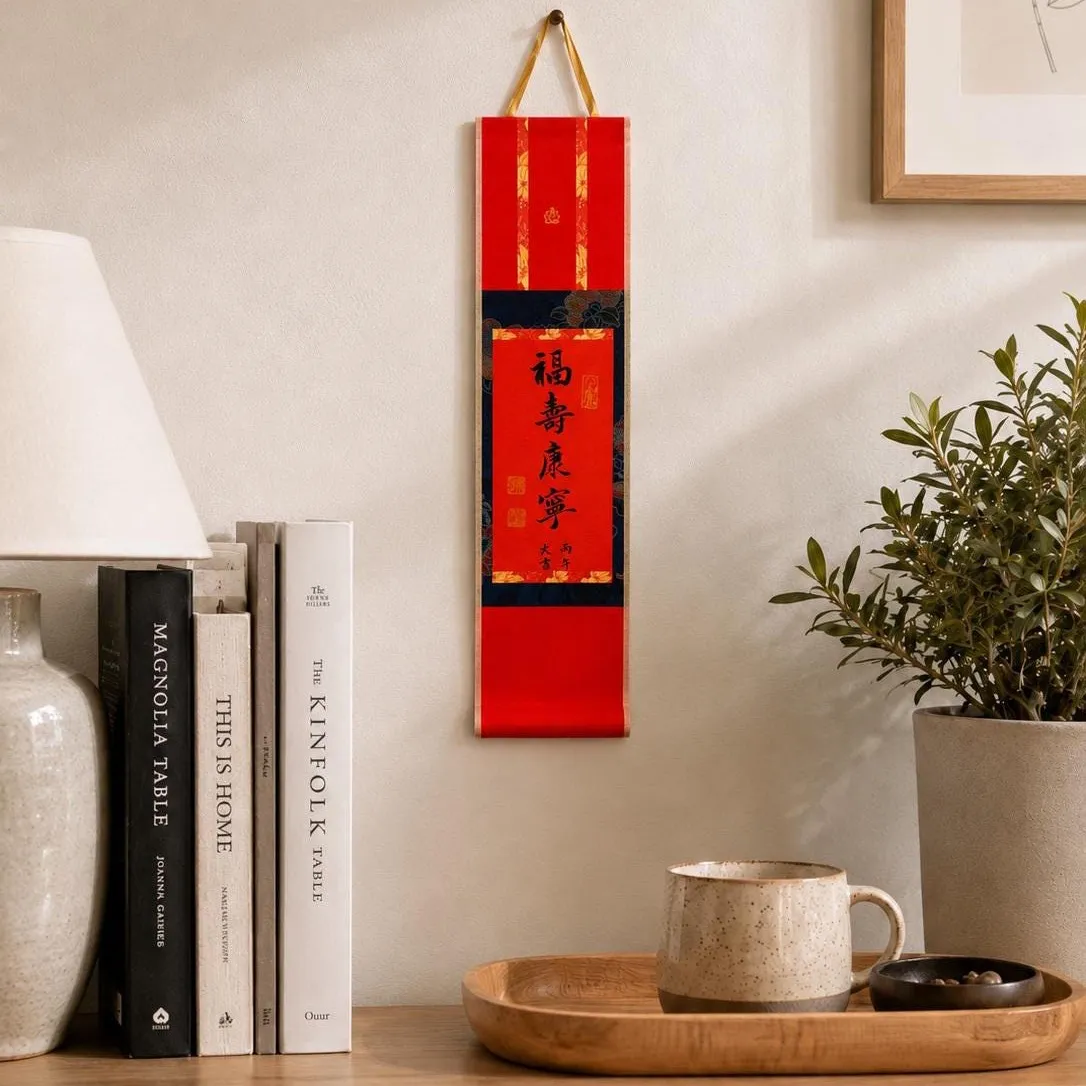
Photo shows a sample — yours will be brushed with the character you choose.
Wall Scroll — for walls & housewarmingsfrom $38→ -
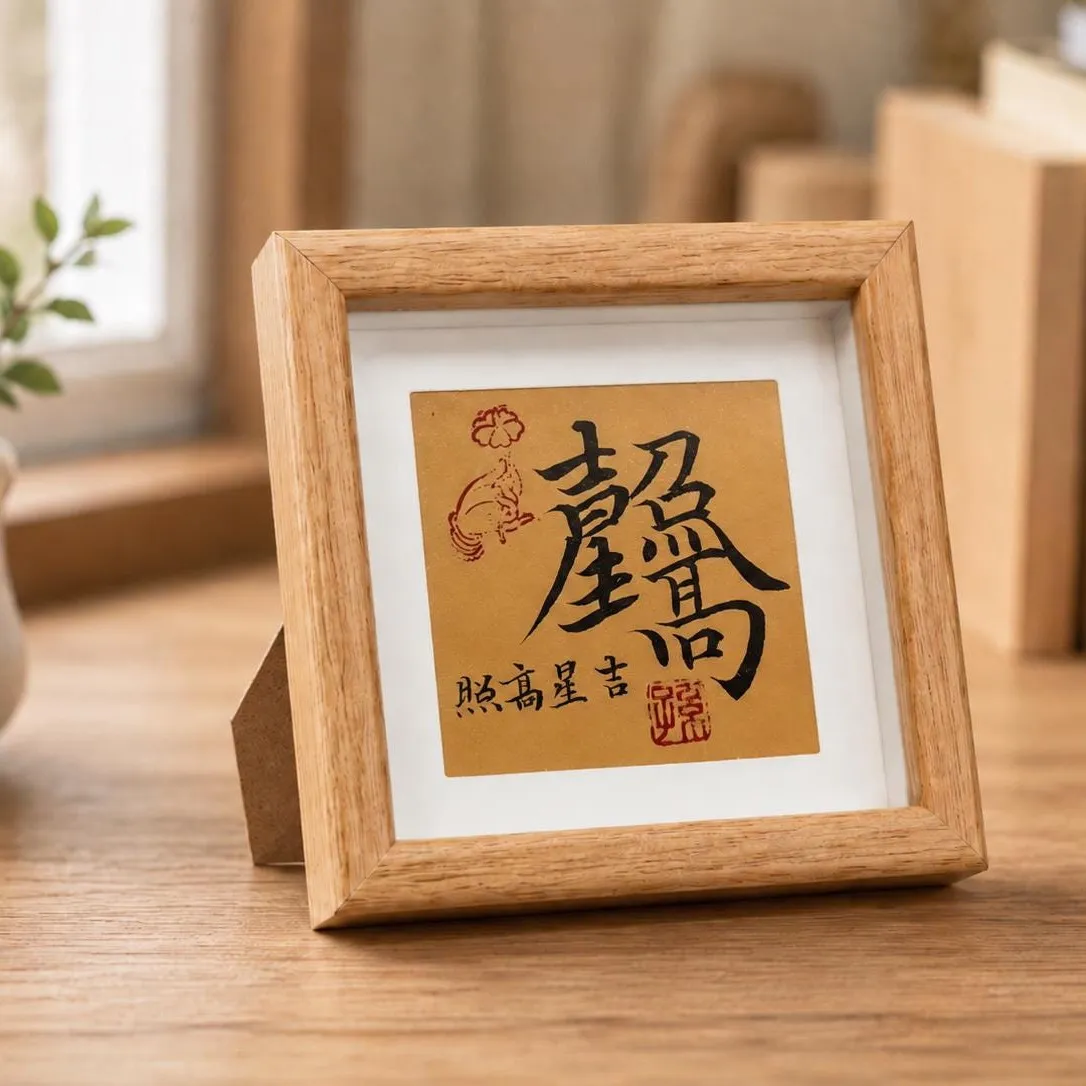
Photo shows a sample — yours will be brushed with the character you choose.
Desk Frame — for desks, studies & studiosfrom $44→ -
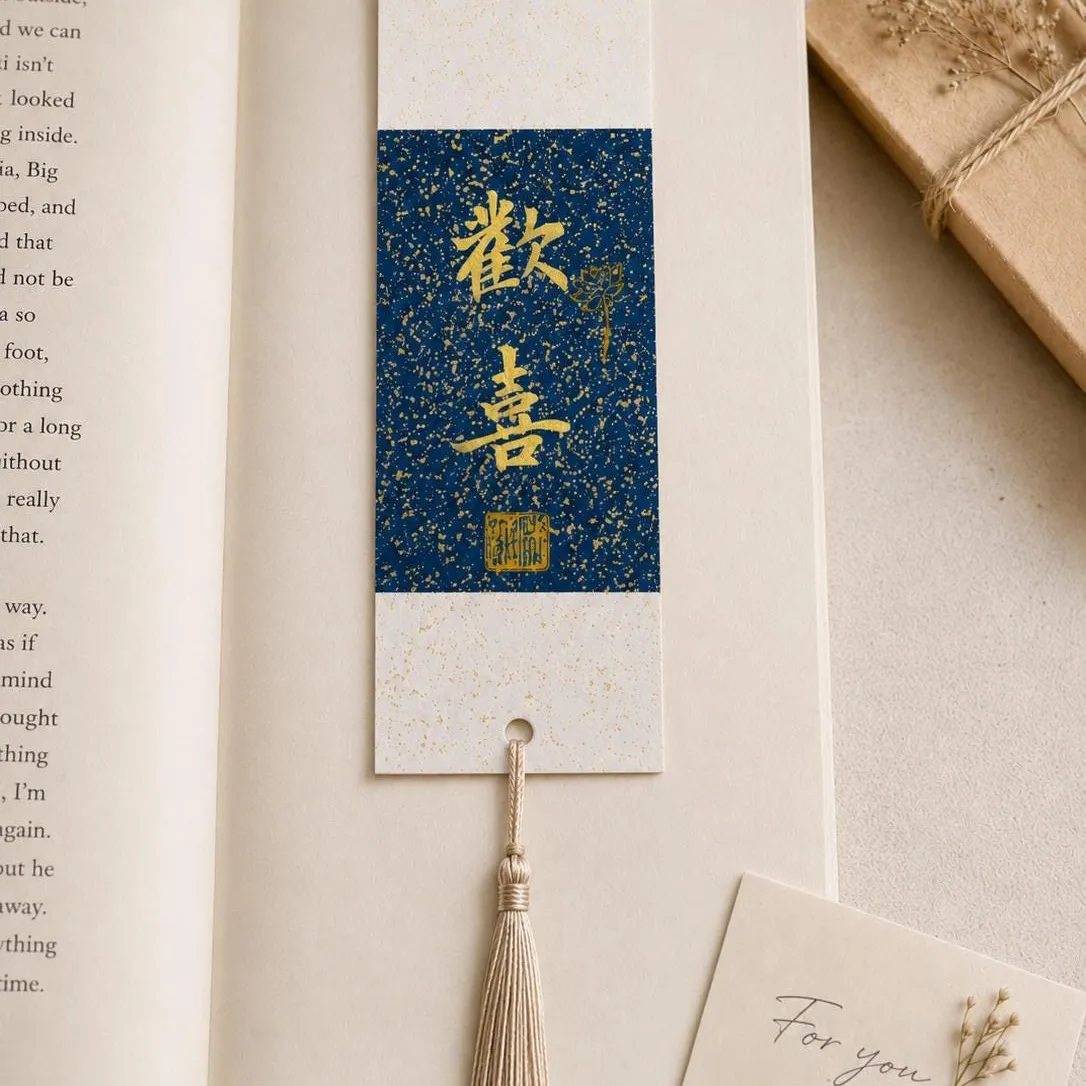
Photo shows a sample — yours will be brushed with the character you choose.
Bookmark — for readers & small thank-yousfrom $17→