For a New Couple
Chinese characters for the engagement, the wedding, the new home — every threshold of a marriage's first year.
Recommended characters
乐 (Lè) — Joy
For the couple at a threshold where the wish is for the life they will build together to be genuinely glad — not just harmonious or prosperous, but specifically joyful in the daily texture. 乐 is the character Chinese people use for the gladness that shows up inside a household, between two people who chose each other; where 和顺 names the accord the marriage needs and 家和 names the household’s foundational state, 乐 names the felt quality of living inside it.
和顺 (Hé Shùn) — Harmony and Smooth Going
For the couple beginning their life together. 和顺 names what a new household actually needs from the start: warmth in the relationship (和) and ease in the daily logistics of shared life (顺). The standard phrase 家庭和顺 in Chinese wedding toasts makes the wish that these two qualities arrive together — a house with only one runs poorly over time.
家和 (Jiā Hé) — Family Harmony
For the couple founding a household together. 家和 addresses the household as a unit — the accord between the people who will share it — rather than the romance between two individuals. Where 和顺 names the specific mechanical conditions a marriage needs (warmth + smooth running), 家和 names the foundational state that holds everything else: the home in accord with itself.
家和万事兴 (Jiā Hé Wàn Shì Xīng) — When Family is Harmonious, All Things Flourish
For the couple whose household is just beginning. Where 家和 names the condition the marriage needs (the household in accord), 家和万事兴 states the full argument: that condition is also the prerequisite for everything else the marriage will produce. The gift for the couple who will live with this proverb above their door for years and, eventually, find it correct.
丰 (Fēng) — Abundance
For the couple founding a household. 丰 names what the household needs beyond harmony — the material and experiential fullness that makes generosity possible: having more than needed means being able to give without diminishing what is yours. Where 和顺 names the accord the marriage needs and 家和 names its foundational state, 丰 names the condition of the table and the year: genuinely full, the measure overflowing.
祥和 (Xiáng Hé) — Auspiciousness and Harmony
For the new couple at Chinese New Year — the first threshold of the year they are building together. 祥和 names what a new household needs from both directions: a world that is favorably disposed toward what they are beginning (祥) and a household they are learning to hold in genuine accord (和). More encompassing than 吉祥 (lucky signs only) or 家和 (domestic harmony only), it names the compound condition that Chinese families have wished for new beginnings for over a thousand years.
和美 (Hé Měi) — Harmony and Beauty
For the new couple at a wedding or in the first year of their marriage. 和美 names both what the day wishes for — the accord of two different natures beginning their music together (和) — and what the years are asked to make of it (美): the beauty that sustained harmony produces in a household over time. More complete than 和顺 (which asks only for smooth daily life) and more specific than 幸福 (which names a feeling), 和美 is the wedding blessing for a couple ready to be told what their accord is meant to become.
福乐 (Fú Lè) — Blessing and Joy
For the new couple at a birthday or New Year — the wish that names both what the life they are building needs (福: the fortunate conditions, the material and relational foundations) and what it should feel like to live inside it (乐: the gladness that runs through the daily texture). More compact than 万事如意 and more personal than 福寿, 福乐 gives the couple the complete double wish: fortune and joy together, the conditions and the experience, in two characters.
花好月圆 (Huā Hǎo Yuè Yuán) — Flowers in Full Bloom · Moon Full and Round
For the new couple at their wedding, 花好月圆 names the occasion itself rather than a quality of the relationship. It identifies the wedding day as the kind of moment the phrase describes: flowers at their best, moon at its fullest, everything arrived at its most complete simultaneously. Unlike 和美, which wishes for what the marriage will become, or 和顺, which names what the household will need, 花好月圆 confirms the present — this day is already that occasion, the circle is already beginning.
百年好合 (Bǎi Nián Hǎo Hé) — A Hundred Years of Harmonious Union
For the new couple, 百年好合 is the most complete of the traditional wedding blessings — the one that names both the duration (百年, the full arc of a lifetime) and the quality (好合, genuinely good union). Where 花好月圆 confirms the wedding day as perfect and 和美 asks for what the marriage will become, 百年好合 asks for the whole span, every year of it, in a state of genuine fitting-together. The blessing that holds everything the couple will be asked to sustain.
五福临门 (Wǔ Fú Lín Mén) — The Five Blessings Arrive at the Threshold
For the new couple at a housewarming or Chinese New Year — the gift that names the complete endowment the threshold of their new shared life is being asked to hold. Unlike 百年好合 (which names the quality of the union across the years) or 花好月圆 (which names the perfection of the starting moment), 五福临门 names the five-part external endowment: the longevity, sufficiency, health, virtue, and good end that the life inside the threshold needs. Most apt when the couple has just crossed into a new home or a new year together — the blessing for the threshold they are beginning to hold.
龙凤呈祥 (Lóng Fèng Chéng Xiáng) — Dragon and Phoenix Display Auspiciousness
For the new couple at a wedding or New Year — the gift that names their union as the form the blessing takes rather than its object. 龙凤呈祥 places the couple at the meeting point of two complementary cosmic forces: the dragon (yang, active, ascending) and the phoenix (yin, receptive, perfected). Where 百年好合 asks for what the union should sustain across time and 花好月圆 names the wedding occasion as complete, 龙凤呈祥 names what the pairing IS: the conjunction of the two forces whose meeting is auspiciousness itself. The oldest and most cosmologically complete of the wedding blessings.
盛 (Shèng) — Flourishing
For the couple whose household is just planted, when the wish is that it thrive — that the home fill with life and the family fortunes rise from this threshold. Where 丰 names the fullness of the table and 家和 names the household in accord, 盛 names the vital, growing energy of a home on the way up: 家道兴盛, the house flourishing across the years. The gift for a new household you want to watch thrive rather than merely settle.
富足 (Fù Zú) — Abundance · Well-Provided
For the couple founding a household, when the wish is for its larder rather than its romance — that the two never want for the basics, that the home they are building rests on a provided foundation. Where 丰 names the overflowing wedding feast and 盛 names the house on the way up, 富足 names the steady material floor a marriage settles into: enough, and a little more, a stocked foundation to build the rest of the life on. The 足 keeps it honest — not a fortune to chase but plenty that registers as full. The gift for the new couple you want to picture secure in the basics from the start.
圆满 (Yuán Mǎn) — Completeness · Perfect Wholeness
For the couple at the wedding when the wish is for the shape of the marriage rather than its larder or its romance — that the life they are beginning comes out whole, the circle closing cleanly with no part missing. Where 富足 names the household’s material floor and 百年好合 wishes the years harmonious, 圆满 wishes the satisfying roundness of the whole: full in measure and complete in shape, a union as round as the full moon behind 花好月圆. The gift for the new couple whose life together you want to picture arriving full, with nothing left wanting.
金玉满堂 (Jīn Yù Mǎn Táng) — Gold and Jade Fill the Hall
For the couple setting up a first home together, when the gift should picture the household abundant rather than the marriage harmonious. 金玉满堂 names the central room of a home filled to capacity with what is most valued — the most concrete of the prosperity blessings. Where 富足 names the quiet sufficiency of a household provided for and 圆满 wishes the marriage’s complete shape, 金玉满堂 names the generous picture: the hall full, the new home wanting for nothing. The housewarming gift for the couple whose first shared threshold you want to wish abundance, not just accord.
年年有余 (Nián Nián Yǒu Yú) — A Surplus Year After Year
For the couple just beginning to keep their own accounts, when the wish is for the security that outlasts any single good year. Where 富足 names the steady material floor a marriage settles into and 金玉满堂 pictures the hall full, 年年有余 names the self-renewing margin: a household that ends each year with something set by rather than spent to nothing, the reserve that comes back season after season. The gift for the new home you want steady from the start — not wealth arriving but shortfall never coming, a place the couple can weather things in because there is always a little more than they need.
阖家幸福 (Hé Jiā Xìng Fú) — Happiness for the Whole Family
For the new couple when the gift should look past the two of them to the two families a wedding now joins — the blessing addressed to the whole household rather than the romance. Where 圆满 wishes the marriage its complete shape and 富足 its material floor, 阖家幸福 wishes the outcome those are for: a good life shared by everyone the union binds together, both sides at once. It is the phrase in-laws reach for over 阖家欢乐 when the wish is not the joy of the wedding day but the lasting well-being of the family the day begins — years, not one evening. The gift for the couple whose marriage you want to picture widening into a whole contented family.
睦 (Mù) — Household Harmony · Concord
For the new couple when the gift should name not the shape of the marriage or its larder but the thing it is made of day to day: 和睦, the warm, unstrained ease between two people sharing one roof. Where 圆满 wishes the union its complete shape and 阖家幸福 wishes both joined families well, 睦 names the accord inside the marriage itself — harmony you could read in how the two meet each other’s eyes, since the character carries an eye (目) and China’s oldest dictionary defines it as 目顺, “the eyes at ease.” The gift for the couple whose new home you want to picture not full or fortunate but harmonious — a house where the people are at ease with one another from the start.
美满 (Měi Mǎn) — Happy and Full
For the new couple when the gift should wish the marriage itself the one thing every elder hopes for it — 婚姻美满, a life together happy and full. Where 圆满 wishes the union its complete shape and 阖家幸福 widens the blessing to both families, 美满 wishes the warmth inside the marriage: 美, good and fine, joined to 满, filled to the brim, so the new home comes out not merely whole but full of what is worth having. It is the two-syllable wish spoken over every couple at the table — happy, and complete. The gift for the marriage you want to picture, years on, as one that turned out good.
兴旺 (Xīng Wàng) — Thriving
For the new couple when the wish is not for the marriage’s shape but for the household to fill up — 家道兴旺, the family’s fortunes climbing, the rooms getting noisier rather than quieter with the years. Where 美满 wishes the marriage itself happy and full and 睦 names the ease between the two of them, 兴旺 looks past the couple to the household they are about to become: growth, traffic, a hearth with a hard-burning fire, the sense of a place that is going somewhere. It is the least private of the wedding wishes, and deliberately so — it wishes them a life with more people in it. The gift for the couple whose new home you want to picture crowded.
紫气东来 (Zǐ Qì Dōng Lái) — Purple Vapor Comes from the East
For the couple at their first shared door — the housewarming or the first New Year of the home they have just made their own. 紫气东来 is written above a lintel, and a marriage’s first home is a lintel newly claimed; the four characters declare that auspicious fortune is drawing toward this threshold from the east. Where 五福临门 names the blessings arriving in full at the couple’s new door and 金玉满堂 pictures the hall already stocked, 紫气东来 names the approach — not what the household holds yet but what is on its way to the life the two are beginning. The forward-looking gift for a couple whose new gate you want to picture with something good already on the road toward it.
幸福美满 (Xìng Fú Měi Mǎn) — Happy and Complete
For the couple at the beginning, when the wish is the fullest one a marriage can be sent. Where 家和 names the accord the household needs and 和顺 the ease of its daily running, 幸福美满 wishes the outcome those make possible: a shared life happy and complete, and lucky to have been either. It is the four-character close of the wedding toast — 祝你们幸福美满 — blessing the new couple from two directions at once, fortune (幸福, well-being with calamity kept away) and fullness (美满, a home good and brimming). The gift for the couple you want to wish not one good thing but all of them together.
旺 (Wàng) — A Fire Going Hard
For the couple’s first winter rather than for the whole arc of the marriage. Most of what a new couple gets wished is long-range — 百年好合 counts to a hundred years, 幸福美满 names the outcome, 兴旺 wants the climb and the heat together. 旺 has no range at all: it describes how hard something is burning right now, which is why it applies to a stove, a crop, a street and a household equally, and stops being true the moment the burning slows. As a wedding or new-home gift that makes it the least ambitious and the most immediate wish on this page — not that the life they are building turn out well, but that the place they are building it in be loud, lit and used from the first month.
同心 (Tóng Xīn) — Of One Heart
For the new couple who have already seen these two characters today without being told what they mean. 永结同心 — forever joined of one heart — runs down one of the red banners in the standard wedding set, and 同心 is the part of it that is doing the work; 永结 only supplies the duration. Given on its own it drops the promise about time and keeps the condition. That makes it the odd one out on a page of first-year wishes: 兴旺 and 旺 want the new home hot and busy, 家和 wants the household in accord, 金玉满堂 wants the rooms stocked, 百年好合 counts out the century. 同心 wants nothing. It states something — that these two are pointed the same way — and leaves the first year to take care of itself.
喜气洋洋 (Xǐ Qì Yáng Yáng) — What the Hall Looked Like
紫气东来 above puts something auspicious on the road toward the couple’s new gate. This one has nothing on the road at all — it describes a room that is already full. 喜 is the wedding’s own character (喜事 for the event, 喜帖 for the invitation, 喜酒 for the banquet, 囍 on the glass), and 洋洋 says the joy did not stay with the two people it belonged to: it reached the aunt who flew in, the colleagues at table nine, the neighbours who came out to watch the car. That makes it a strange and good thing to hand a couple afterwards, because they were the two people least able to see it while it was happening. Where 百年好合 speaks to the century ahead and 同心 states a condition about the pair themselves, this one gives them back the day as their guests had it.
春 (Chūn) — The Sound Inside It Means Hard Going
The component that gives 春 its sound is 屯, and 屯 has its own entry in the 说文解字: 難也, hard going. So the character for spring carries an honest account of what starting is like inside its own pronunciation, which is a better thing to hand a couple in their first year than most of what gets handed to them. 同心 higher on this page states that the two of them are pointed the same way. 春 says the pushing has begun, and declines to pretend it is easy.
兴 (Xīng) — Nobody Lifts It Alone
兴 makes the least sentimental case for marriage in this library, and it is made by the shape of the character. China’s first dictionary defines it in two characters, 起也, to rise, and then explains the shape in three more — 同力也, by joint force. Rising and doing-it-together are one event, which is a claim about arithmetic rather than about feeling. Two other entries on this page carry this character inside them and both put it somewhere else: 兴旺 wants the new home already hot and busy, and 家和万事兴 makes 兴 the consequence and harmony the condition. Alone it is the bare verb, at the stage a first-year household is actually at. 兴家立业 — build the household up, get the work established — is what Chinese says to people who have just set up on their own, and both halves of it are things being done rather than things being enjoyed.
吉 (Jí) — Already Inside the Ceremony
The traditional wedding runs on six steps, 六礼, and the third is named after this character: 纳吉 — the groom’s family takes the bride’s name, obtained at the step before, to the ancestral temple, divines, and, if the answer comes back 吉, sends word that the match may go ahead. The word never left. 吉期 is still the standing Chinese term for a wedding date, and 择吉 — picking the day — is the one piece of the old procedure most couples still perform, even if it now means checking a handful of dates against a calendar before booking anything. 吉祥 and 吉祥如意 elsewhere on this page carry this character inside them and use it as an umbrella over the whole field of good things. Alone it does the smaller, older job it did at step three: the answer that the date is the right one, and that the two families may proceed.
和睦 (Hé Mù) — Everyone Else Who Came With Them
For the couple on the day the roster arrives. 和睦 has no singular — nobody is 和睦 the way a person is patient or generous — so its subject is collective, paired, or supplied by a 与-phrase: 一家和睦, 邻里和睦, 婆媳和睦, 与邻居和睦相处. That is the difference from 睦 further up this page, which is a conduct one person performs toward their kin; the compound is a state, and a state needs more than one party to be in. It is also what separates it from 家和, which is frozen to its one subject — there is no 邻里和 and no 婆媳和, 家 being the only thing 和 pairs with that way — where 和睦 is productive and will take any two parties you name. 和顺, meanwhile, measures one household’s warmth and workability; 和睦 asks the plural question underneath it: who in there is at ease with whom. A wedding is the hour two people acquire a whole set of relationships nobody picked, and this is the blessing pointed at the set rather than at the pair standing in the middle of it.
一元复始 (Yī Yuán Fù Shǐ) — Their Own Count, Starting
元年 is not a date in the calendar. It is what a count is called in its first year, and it belongs to whatever has newly taken the seat — a reign begins its own numbering at 元年 rather than joining anyone else’s, which is the question 《公羊传》 stops to ask on the opening line of the 《春秋》. The pattern is still producing: Chinese now says 电商元年, AI元年 — year one of something that did not previously exist, counted from itself. A household does the same thing. Two people who have just set one up are not continuing either family’s count; they have started a third, from a standing start, and everything in the rooms is in its first year of being theirs. 春 elsewhere on this page marks the date a place begins counting from and asks for no evidence that the counting comes to anything, which is the closest neighbour here. This names what is being counted: not the season but the reign, the head of a series that belongs to nobody else. For the couple whose first New Year in their own place is also the first entry in it.
缘 (Yuán) — The Story They Are Still Being Asked to Tell
In a marriage’s first year one story gets told more often than any other, to every relative and every new colleague, usually by both of them at once and rarely the same way twice: how the two of them met. 缘 is the Chinese word for the content of that story. Not the marriage and not the household, but the run of ordinary accidents behind it — the transfer nobody asked for, the party one of them nearly skipped, the last seat left on a carriage. The character began as a garment’s edging, the silk band sewn where the cloth stops, and every later sense is that edge moved: to travel along something, and then to be the reason for something. What a couple is said to have is a length of alongside-ness. 良缘 is already in circulation around them — on the invitation, on the banner over the head table — but it arrives there as decoration on somebody else’s stationery. Given as a piece of its own, it names the one part of the first year the two of them are the only witnesses to.
天长地久 (Tiān Cháng Dì Jiǔ) — The Far End of a Count They Just Started
一元复始, elsewhere on this page, names the moment a household begins a count that belongs to nobody but itself. These four characters name the other end of that count. What makes them hangable in the first month is the size of the measure rather than anything the couple has yet done: the sky and the ground were running long before these two met, so the term is borrowed rather than earned, and a marriage with nothing to show for itself can be given it without the gift looking premature. 缘, above, is about the accidents behind the introduction. This one sets a length against them.
祥云 (Xiáng Yún) — Above the Roof, Not Between the Two of Them
Newly married people get told a great deal about what they are now supposed to become. This word asks them to be nothing in particular. 祥云 is aimed at the sky over the place rather than at anything happening inside it, so what it hands over is a description of the conditions, with the household left to turn out however it turns out. On a wedding sheet the cloud is rarely drawn on its own — a dragon and a phoenix ride in on it, and the cloud is what they are standing on. Given on its own it carries nobody, and that is the argument for giving it on its own: it is the sky the two of them get, not a figure they are being asked to be. A report is not something anybody has to live up to.
琴瑟 (Qín Sè) — An Ensemble from the First Room
百年好合 counts a hundred years of good union; 同心 wants the two of them aimed the same way before the years have accumulated evidence. 琴瑟 is the older instrument picture underneath those wishes: two complete voices that will have to play together in the new household. A scroll with this pair does not pretend the music is already finished. It says the marriage is being started as an ensemble — which is what 琴瑟和鸣 is still doing in the toast over their table.
白头偕老 (Bái Tóu Xié Lǎo) — The Far End Named on Day One
花好月圆 congratulates the evening; 缘 points backward at how they met; 琴瑟 asks whether two instruments will play in the first rooms. 白头偕老 points past all three, to a morning decades out when the hair has gone white and the question is only whether both people are still in the frame. For the couple who want the wedding gift to name the ending while the beginning is still being set.
五谷丰登 (Wǔ Gǔ Fēng Dēng) — Provision for the First Kitchen
家和 names the household in accord; 金玉满堂 pictures the hall furnished; 年年有余 leaves a surplus on the books. 五谷丰登 wishes the new couple the harvest kind of provision — staple grains come in, the first kitchen not guessing at a thin year. For a housewarming or New Year when the gift should say the home is fed in the agrarian sense.
悦 (Yuè) — Each Pleased by the Other
乐 wishes the household a glad daily texture. 喜气洋洋 describes what the hall looked like when the news was public. 琴瑟 asks whether two instruments will answer each other in the first rooms. This character is smaller than those jobs. It says each person is pleased by the other, the heart’s yes, which 《尔雅》 also files as 服, being won over. A count of decades can wait. A first year can already report the pleasure of one another. A wedding room has its drum. This gift leaves the drum where it is.
福 (Fú) — Blessing · Good Fortune · Happiness
See 福 →安 (Ān) — Peace · Safety · Tranquility
See 安 →和 (Hé) — Harmony · Balance · Togetherness
See 和 →喜 (Xǐ) — Joy · Happiness · Celebration
See 喜 →吉祥 (Jí Xiáng) — Auspiciousness · Good Omen · The Promise of Good Things
See 吉祥 →如意 (Rú Yì) — As You Wish · Aligned with the Heart
See 如意 →喜乐 (Xǐ Lè) — Joy · Daily Gladness · The Quiet Warmth That Lasts
See 喜乐 →阖家欢乐 (Hé Jiā Huān Lè) — Joy for the Whole Household
See 阖家欢乐 →顺 (Shùn) — Smooth Going · Flowing Well · Without Obstruction
See 顺 →福至 (Fú Zhì) — Blessings Arrive · Fortune Has Come
See 福至 →吉祥如意 (Jí Xiáng Rú Yì) — Auspicious · As You Wish · A Year That Unfolds Well
See 吉祥如意 →Bring a hand-brushed piece home — choose how you'd like it brushed.
-
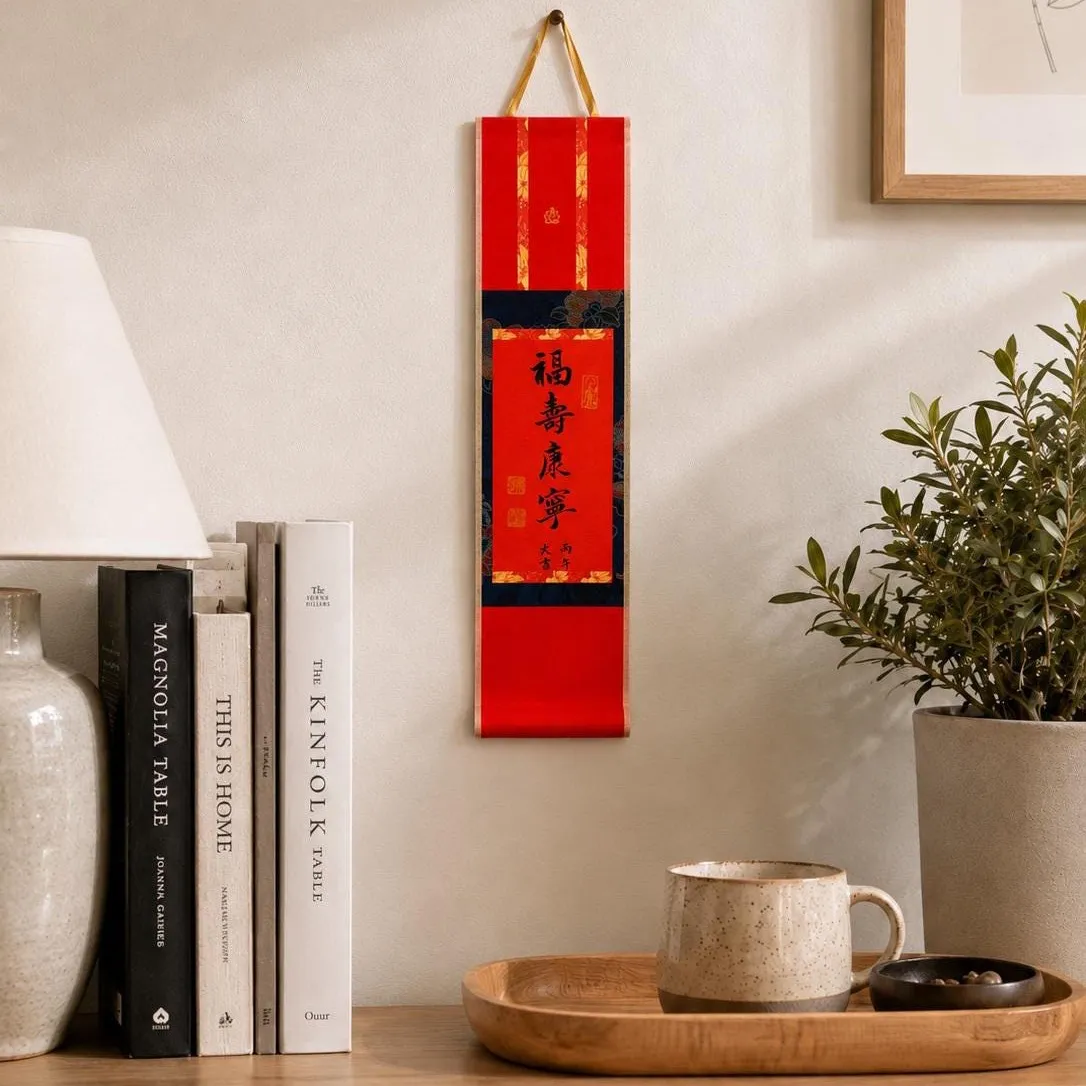
Photo shows a sample — yours will be brushed with the character you choose.
Wall Scroll — for walls & housewarmingsfrom $38→ -
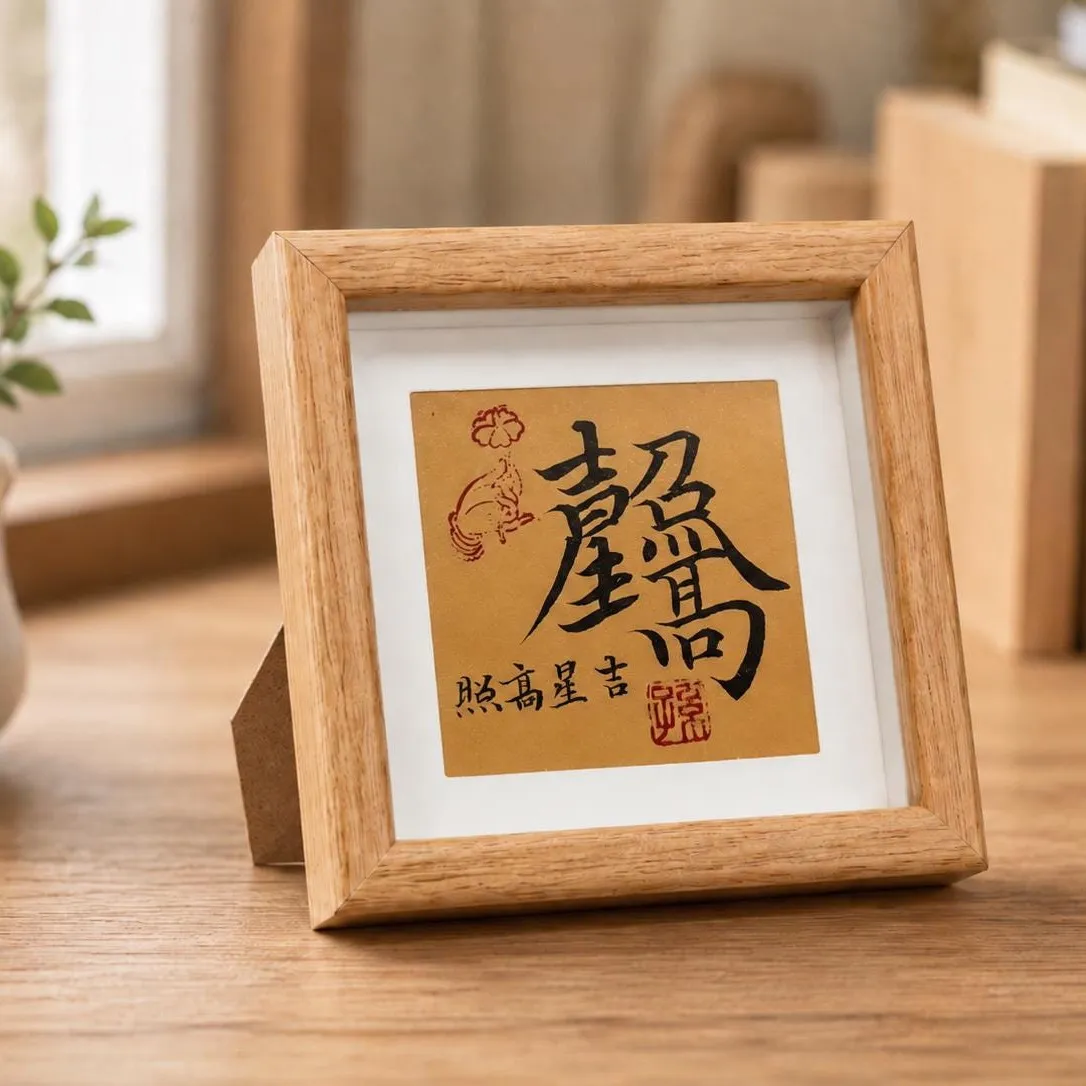
Photo shows a sample — yours will be brushed with the character you choose.
Desk Frame — for desks, studies & studiosfrom $44→ -
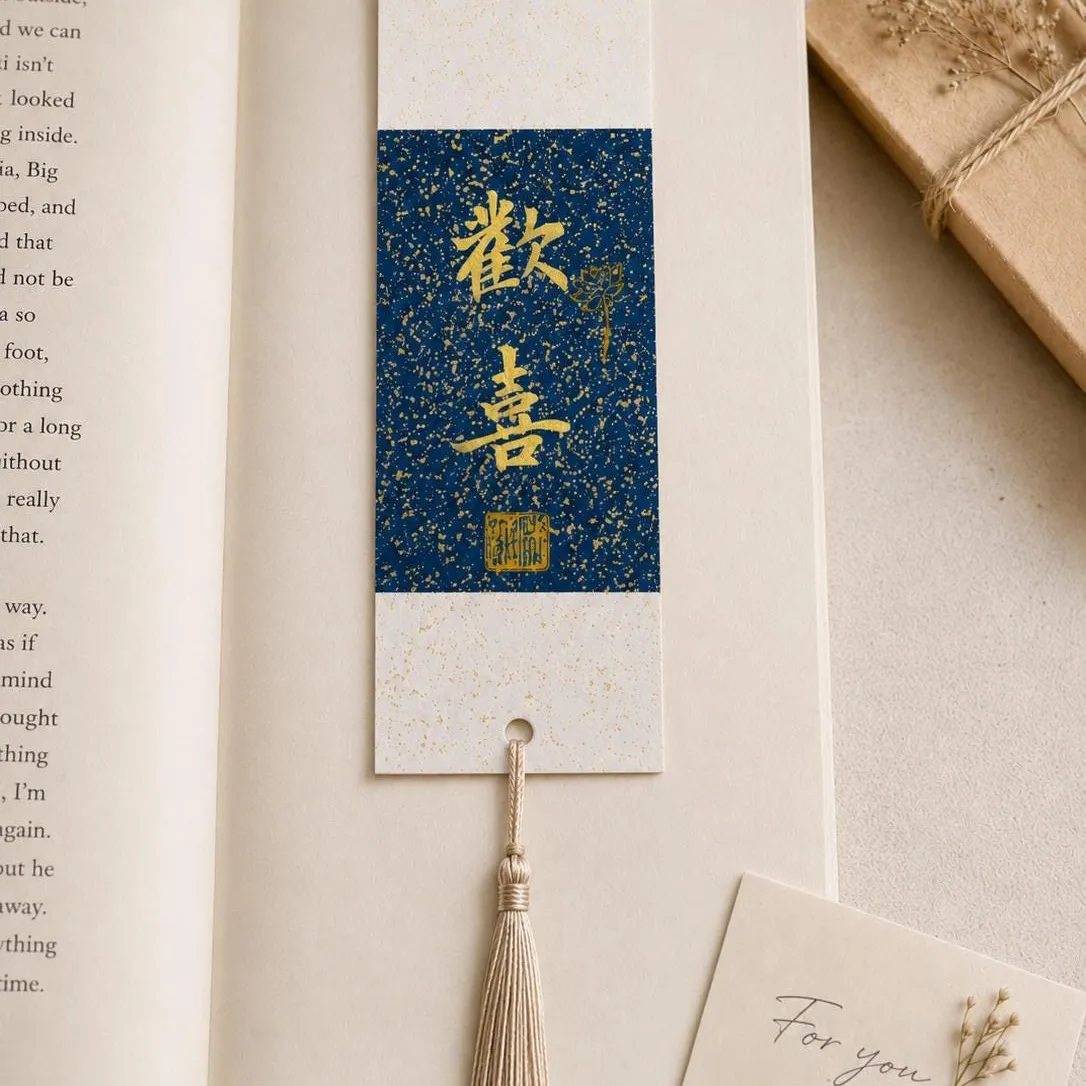
Photo shows a sample — yours will be brushed with the character you choose.
Bookmark — for readers & small thank-yousfrom $17→