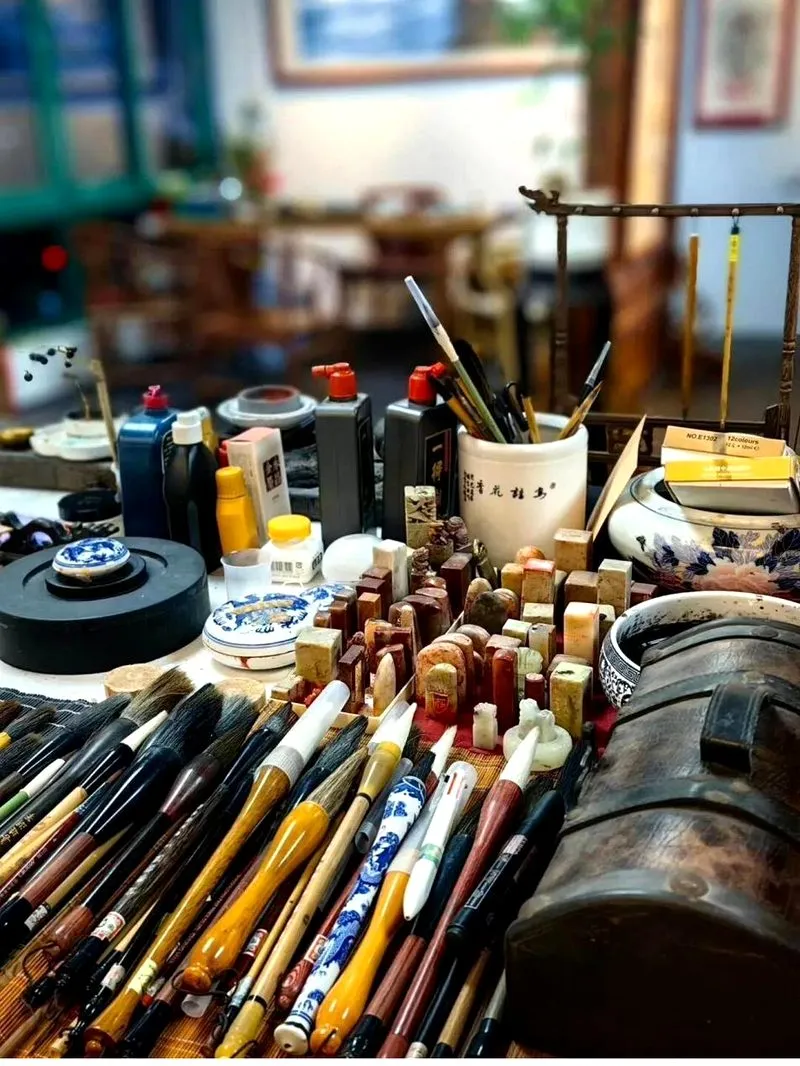
Mother's Day Gifts
Chinese characters for Mother's Day — for the woman who carried you. Restrained, lasting, deeply Chinese.
Recommended characters
孝 (Xiào) — Filial Piety
For Mother’s Day when the gift should name the relationship’s direction rather than wish for anything. 孝 is not prospective — it does not wish health or longevity (those are 康宁 and 长寿). It is a recognition: that the years of care have been received, that the debt is understood, and that this occasion is specifically for saying so. The most structurally honest of the Mother’s Day choices.
长寿 (Cháng Shòu) — Longevity
For Mother’s Day when continued presence is the gift. 长寿 makes the plainest longevity wish — more years, unqualified — and is the right choice when what you want to express is not comfort or ease (that is 安康 or 康宁) but simply that she goes on being there.
康宁 (Kāng Níng) — Health and Ease
For Mother’s Day when the wish names both what the body needs and what the mind deserves. 康宁 pairs health (康) with settled calm (宁) — the two conditions that together describe a life that feels well, not just medically adequate. For the mother who has spent years managing others’ wellbeing, 康宁 is the wish that both registers of her own are finally at ease.
雅 (Yǎ) — Elegance
For Mother’s Day when the gift should name a quality of character rather than wish for health or longevity. 雅 is more specific than 美 (which names beauty in the abstract) and more personal than 德 (which names accumulated virtue). It names the cultivated sensibility — the particular way she has shaped the spaces and occasions around her over years. A recognition gift for someone whose quality of attention you have been absorbing for a long time.
贤 (Xián) — Worthy Character
For Mother’s Day when the gift should name demonstrated worth rather than add to the wishes. 贤 is more specific than 孝 (which names the child’s obligation toward the mother) and more practical than 德 (which names virtue in the abstract). It names what the mother’s role actually required — competence and character, in conditions that tested both — and recognizes that she met that standard.
仁爱 (Rén Ài) — Benevolent Love
For Mother’s Day when the gift should name not the feeling of love but the quality of love demonstrated over decades — the sustained, selfless orientation that 仁爱 names and that 爱 alone does not reach. More specific than 孝 (which names the child’s obligation toward the mother) and more grounded than 贤 (which names demonstrated worth broadly), 仁爱 names the particular practice: loving with a love that kept pointing outward past the point it was expected to return.
温 (Wēn) — Warmth
For Mother’s Day when the gift should name the temperature of her care rather than its quantity or its virtue. 温 names what you felt in the room before you had a word for it — the steady, mild warmth that never ran hot or cold. More specific than 爱 (which names the love itself) and warmer than 慈 (which can stay dignified, even formal), it is the recognition for the mother whose presence, more than anything she did, is what being home actually felt like.
润 (Rùn) — Quiet Nourishment
For Mother’s Day when the gift should name how her care worked rather than how it felt — the soaking, almost invisible giving that did its work while you were too young to notice. 润 is the spring rain of 润物细无声: nourishment recognized only by what it grew. Where 温 names the warmth you felt in the room and 孝 names the debt owed back, 润 names the quiet nourishment itself — the right choice for the mother whose steady, soft care you can only measure now, in everything it left greener.
慈 (Cí) — A Mother’s Tender Love
For Mother’s Day when the gift should name the direction of her love rather than its warmth or its virtue. 慈 is the parent’s half of the bond — the protective love that flows downward and asks for nothing back — and the character built into 慈母, the loving mother of the language’s most quoted poem. Where 孝 names the debt owed back to her and 温 names the warmth you felt in the room, 慈 names the love itself as only a parent gives it: the most precisely maternal of all the choices.
清雅 (Qīng Yǎ) — Pure Elegance
For Mother’s Day when the gift should name a quality of taste rather than wish for health or longevity — and specifically the clean, fresh register of it. 清雅 is the orchid-and-ink kind of refinement: a single branch in a plain jar, a household kept uncluttered, an eye that reached for the limpid over the lavish. More specific than 雅 (which names cultivated taste in general) and cooler than 美 (which names beauty itself), it names the cool, clear elegance the mother carried — the register her restraint produced over years.
温润 (Wēn Rùn) — Warm and Smooth as Jade
For Mother’s Day when the gift should bind together the two qualities her 温 and 润 sections name separately — the warmth you felt in the room and the soaking, spring-rain care you only measured later. Jade is loved for being warm and smooth at once, a glow that comes from within and rewards being close, and 温润如玉 made that the standard for a gentle character. Where 温 names her warmth alone and 润 names her quiet nourishment alone, 温润 names the whole texture of being raised by her: warm to be near, and smooth. The recognition for the mother whose care was warm without ever being loud.
慈祥 (Cí Xiáng) — Kindly and Gentle
For Mother’s Day when the gift should name not the love itself but the way it now shows on her face. 慈母 names the tenderness; 慈祥 names what that tenderness looks like after decades — the soft eyes, the unhurried smile, the kindness that has become visible demeanor. Where 慈 names the protective love that flows downward and 温 names the warmth you felt in the room, 慈祥 names the benign, gentle bearing reserved for an elder mother — the kind face her children and grandchildren will picture first. Most apt for the mother whose long love has settled into how she looks back at you.
容 (Róng) — The Capacity to Hold
For Mother’s Day when the gift should name the room she made rather than the warmth she gave or the years she has lived. 容 is 包容 — the capacity to take a child in whole, moods and mistakes and wrong turns, and hold them without asking for anything different first. Where 慈 names the protective love that flows downward and 温 names the warmth you felt in the room, 容 names the act of containing itself, and the 从容 — the unhurried composure — that a lifetime of making room leaves on a face. Most apt for the mother whose patience you only measured once you had to try to match it.
秀 (Xiù) — Outstanding and Finely Made
For Mother’s Day when the gift should name her distinction rather than her warmth or her years — the outstanding, finely made quality her family has always taken for granted. 秀 means outstanding and gracefully refined at once, beauty with real substance behind it, which is why it has filled Chinese women’s given names for generations. Where 清雅 names the clean, understated register of her taste and 慈祥 names the kindness her face has settled into, 秀 names the plain fact of how she stands out — 秀外慧中, graceful without and wise within. Most apt for the mother whose refinement looks effortless because it is genuinely her own.
清 (Qīng) — Clarity and Cleanness
For Mother’s Day when the gift should name a quality of clearness rather than wish for health or longevity. 清 is the clean conscience she raised you by, the uncluttered calm she kept a household on, the fresh and unforced way she carried herself. More elemental than 雅 (cultivated taste) and cooler than 慈 (tender love), it names the transparency of her character — a life with nothing murky folded into it. The recognition for the mother who has been clear water to everyone around her.
博爱 (Bó Ài) — Universal Love
For Mother’s Day when the gift should name the reach of her love rather than its warmth or its virtue — the mother whose care spilled past her own children to whoever needed it. 博爱 is the width of the heart: the mom every kid on the street called 阿姨, who set an extra place without being asked. More outward than 慈 (the tender love a mother aims at her own young) and broader than 仁爱 (the sustained care she poured into the family), it names the rarer thing — love large enough to hold people who were never hers to raise. Most apt for the mother whose warmth was never a private supply.
端庄 (Duān Zhuāng) — Dignified Grace
For Mother’s Day when what you most want to name is her bearing — the composed, dignified poise that has always been the atmosphere around her. 端庄 is not warmth (温) or tenderness (慈) or elegance (雅); it names the gravity beneath them, the self-possessed grace that makes a room settle. The choice for the mother whose dignity is quiet, steady, and entirely her own.
感恩 (Gǎn Ēn) — Gratitude
For the Mother’s Day gift that names a feeling toward her rather than a wish for her — gratitude for years of care that cannot be itemized or repaid. Where 孝 names the duty of filial care and 慈 names the tenderness she gave, 感恩 names the child’s side of it: the heart finally turning to weigh what she gave and being moved by the size of it. Most apt for the mother to whom you want to say, plainly, that the debt is felt — 感恩 is the character for gratitude grown up enough to understand how large it is.
身体健康 (Shēn Tǐ Jiàn Kāng) — May Your Body Be Well
For the Mother’s Day when the honest gift is not a tribute but a wish. Most of the day’s vocabulary looks backward — 孝 names the debt, 慈 names the tenderness she gave, 感恩 weighs what it all came to. 身体健康 is the one that faces the other way, and it names the body specifically rather than folding calm into it the way 安康 does: the plain spoken formula that opens a toast to an elder and closes a letter home. Most apt for the mother whose well-being you monitor from a distance and almost never mention to her.
婉 (Wǎn) — Gentle in the Turn
For the Mother’s Day gift that credits her method rather than her nature. Most of the character gifts on this page name something she is — 慈 the tenderness, 温 the warmth, 容 the room she made for things she had not agreed to, 端庄 the composure. 婉 names a technique, and one she had to choose every time: routing a hard thing so that it arrived in a form you could actually use. It is easiest to measure by what is missing from the record — the argument that never happened, the subject quietly changed instead. Chinese has a term of art for it, 婉而成章, indirect yet fully formed, though it was coined about historiography rather than about mothers. Most apt for the mother whose delivery you only decoded years after the fact.
岁月静好 (Suì Yuè Jìng Hǎo) — A Wish Pointed Forward
There is a version of this wish you can say to her face, and a version you cannot. 身体健康, above, is the first kind. 岁月静好 is the second — a wish about years that have not happened yet, whose entire content is that nothing happens in them, said without naming a single one of the things you are actually afraid of. It is a strange thing to want for anyone, until you are old enough to be the one doing the worrying. There is a second reading available on this particular day. For most of your childhood the quiet in the house was something she produced and nobody mentioned; the phrase names it, decades late, as the good thing rather than the background.
柔 (Róu) — What Was Still There Afterwards
There is a story Chinese keeps for this character, recorded by 刘向: an old teacher on his deathbed opens his mouth so Laozi can look inside. The tongue is still there. The teeth went years ago. Soft outlasted hard, and the demonstration takes about four seconds. 慈, further up this page, names the direction a mother’s love points — downward, at a child. 柔 names what that love does when something pushes back on it: the thing that gave way in the moment and turned out, decades later, to be the part still standing. For the mother who absorbed what a household generates without passing any of it on — a harder thing than it sounds, and the reason the household still has its shape.
安心 (Ān Xīn) — The One You Have to Be the Cause Of
孝 and 感恩 higher up this page look backward, at what she did, and that is why they can be given sincerely by a child whose own life is a mess. Nothing about the giver has to be true for them to land. 安心 looks the other way. It is a verb with an object — settle the heart — and it reports that one thing she has been keeping an eye on no longer needs it, which is a claim about a state of affairs rather than a sentiment about her. The only way to make it true is to be the reason it is true. On a day built almost entirely out of things you can say to her, this is the one you have to have done.
母慈子孝 (Mǔ Cí Zǐ Xiào) — Quoting the Job Description
父义,母慈,兄友,弟共,子孝 — the 五教, the five household teachings the 《左传》 credits to Shun, one position and one character each. The mother’s allotted character is 慈, and 母慈子孝 is two of those five line items lifted out and set next to each other. What you are giving her, then, is a citation rather than a compliment: not that she was wonderful, which is a feeling and cannot be checked, but that she filled the position, followed by the name of the position. It is the coolest thing on this page and, for some mothers, the only one that will not embarrass them. For the woman whose work you would rather have credited than praised.
逸 (Yì) — Not the Afternoon Off, the Condition
The standard Mother’s Day gesture is a suspension: the brunch, the day of being served, the twenty-four hours in which she is asked not to do anything. Everyone involved knows it resets on Monday. 逸 is the character for being out from under something, and the reason it is worth handing over on this particular day is that it names the something — which the brunch conspicuously does not. Chinese has been arguing about whether ease can be deserved since the Western Zhou, and the answer it arrived at is a test rather than a verdict: the ease belongs to whoever has already found out what the work costs. Applied to this particular occasion the test has an awkward edge, because it does not ask how much anyone loves her. It asks who in the house has done the work, which is a question with a checkable answer. She passes it, and most of the people buying her flowers do not.
平和 (Píng Hé) — The Word a Pharmacopoeia Uses
Chinese materia medica grades a herb partly on whether it tips the body hot or cold, and the grade for one that does neither is 平 — 药性平和 is the phrase that follows from it, and it means safe to keep giving over a long course, because nothing it does needs correcting later. The word is not being borrowed here as a metaphor; it is the same word, unchanged, and Chinese uses it unchanged of a person’s temper and of a voice. That range is what makes it an odd and good thing to give on this particular day. Mother’s Day usually asks for a verdict on how she made everyone feel, and 岁月静好 elsewhere on this page points the wish forward at years she has not had yet. 平和 does neither. It reports on the years already spent, and the quantity it reports is the one nobody notices while it is holding.
春暖花开 (Chūn Nuǎn Huā Kāi) — May Already Answers
孝 recognizes the debt; 慈 names her tenderness; 岁月静好 covers years with nothing to report. 春暖花开 is the Mother’s Day phrase that matches the month on the calendar: late spring, warm air, flowers open — garden-season language without wedding romance. For the card that should thank her with a season that has already shown up.
恩 (Ēn) — Before the Thanks
感恩 above is the heart moved by what she gave. 慈 names tenderness as her disposition. This character stops one step earlier. It is the kindness that landed — coats, fees, meals — including in the years before the child managed any feeling about them. 孝 would put the child’s duty in the sentence. Mother’s Day can be the day the favor is written down on its own. The pair that adds the feeling already has a section here. The single character is for the giver who wants the favor named.
福 (Fú) — Blessing · Good Fortune · Happiness
For the parents who have shaped your life. "福" is a quiet way to wish them health, peace, and the comfort of a life well lived.
See 福 →爱 (Ài) — Love · Affection · Devotion
For the parents whose love has shaped you. "爱" is a gentle way to say what is hard to put into words.
See 爱 →寿 (Shòu) — Longevity · Long Life · Health and Vitality
For the parents whose long lives have shaped your own. "寿" is the wish for many more good years.
See 寿 →安 (Ān) — Peace · Safety · Tranquility
For the mother whose peace of mind is always last on her own list. 安 turns the wish around — a hope that her days are quiet, safe, and restful.
See 安 →康 (Kāng) — Health · Well-being · Wholeness
For the mother who has carried more than most people see. 康 is a precise wish — not for anything grand, but for her days to feel well and unhurried.
See 康 →静 (Jìng) — Stillness · Tranquility · Quiet
For the mother who has not stopped moving since before you can remember. 静 is the wish that is rarely spoken and almost never given — not for health or another good year, but for the interior stillness that would let her experience those things. The most specific Mother's Day character in the library.
See 静 →安康 (Ān Kāng) — Peace · Health · Wholeness of Body and Mind
For the parent whose body has carried more than most people see. 安康 is a quiet, specific wish: that their days feel easy and their health holds, year after year.
See 安康 →福寿 (Fú Shòu) — Blessing · Longevity · A Long and Happy Life
For the parents whose long lives have shaped your own. 福寿 is the wish that the years ahead are as full as they are many.
See 福寿 →力 (Lì) — Strength · Force · The Power to Act
Chinese has a phrase, 力量, that means inner strength, moral force, the capacity to hold things together. For the parent who has been that kind of force — quietly, for years — 力 names it.
See 力 →岁岁平安 (Suì Suì Píng Ān) — Peace Year After Year
For the parents whose well-being you most want to last, 岁岁平安 names exactly that — peace, repeating, year by year.
See 岁岁平安 →健康长寿 (Jiàn Kāng Cháng Shòu) — Good Health · Long Life
For the parents whose continued health is the gift you most want to give back. 健康长寿 names what every other blessing for them ultimately rests on.
See 健康长寿 →龙马精神 (Lóng Mǎ Jīng Shén) — The Vigor of the Dragon and Horse · Tireless Spirit
For the parent who never stops, 龙马精神 names the quality you have noticed and wishes it forward — vitality that keeps showing up, year after year.
See 龙马精神 →善 (Shàn) — Goodness · Kindness · Moral Virtue
For the mother whose kindness toward others — not only her own children — you have spent a life observing. 善 does not wish her health or peace; it names what she has already been.
See 善 →福寿康宁 (Fú Shòu Kāng Níng) — Blessing · Longevity · Health · Peace
For the parent who does not ask for gifts, 福寿康宁 names the four things they actually want — and the four things their children most hope for on their behalf.
See 福寿康宁 →福寿安康 (Fú Shòu Ān Kāng) — Blessing · Longevity · Peace · Health
For the parents whose lives have shaped your own, 福寿安康 is the full wish — not abbreviated, not narrowed to one virtue. The whole blessing, named in full.
See 福寿安康 →Bring a hand-brushed piece home — choose how you'd like it brushed.
-
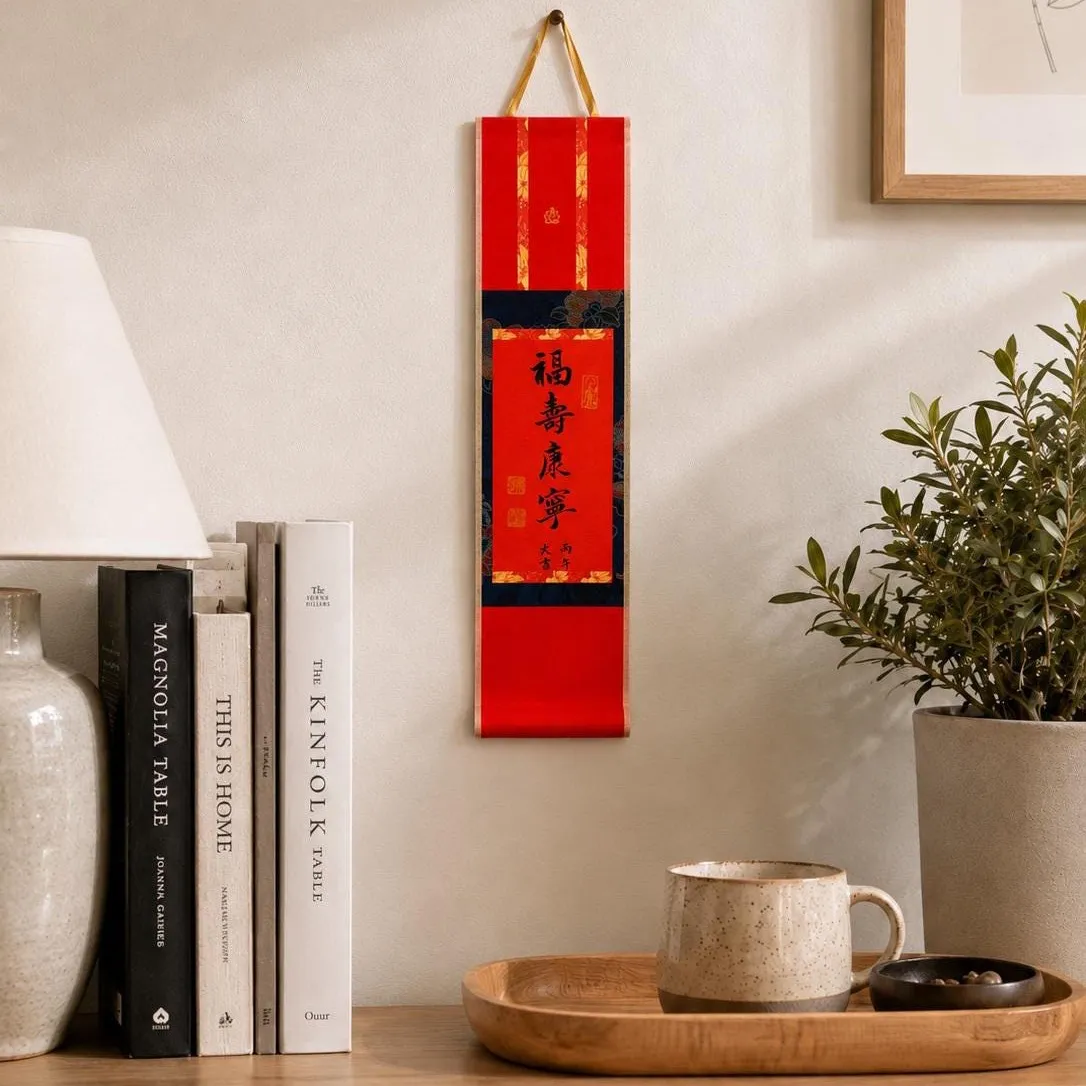
Photo shows a sample — yours will be brushed with the character you choose.
Wall Scroll — for walls & housewarmingsfrom $38→ -
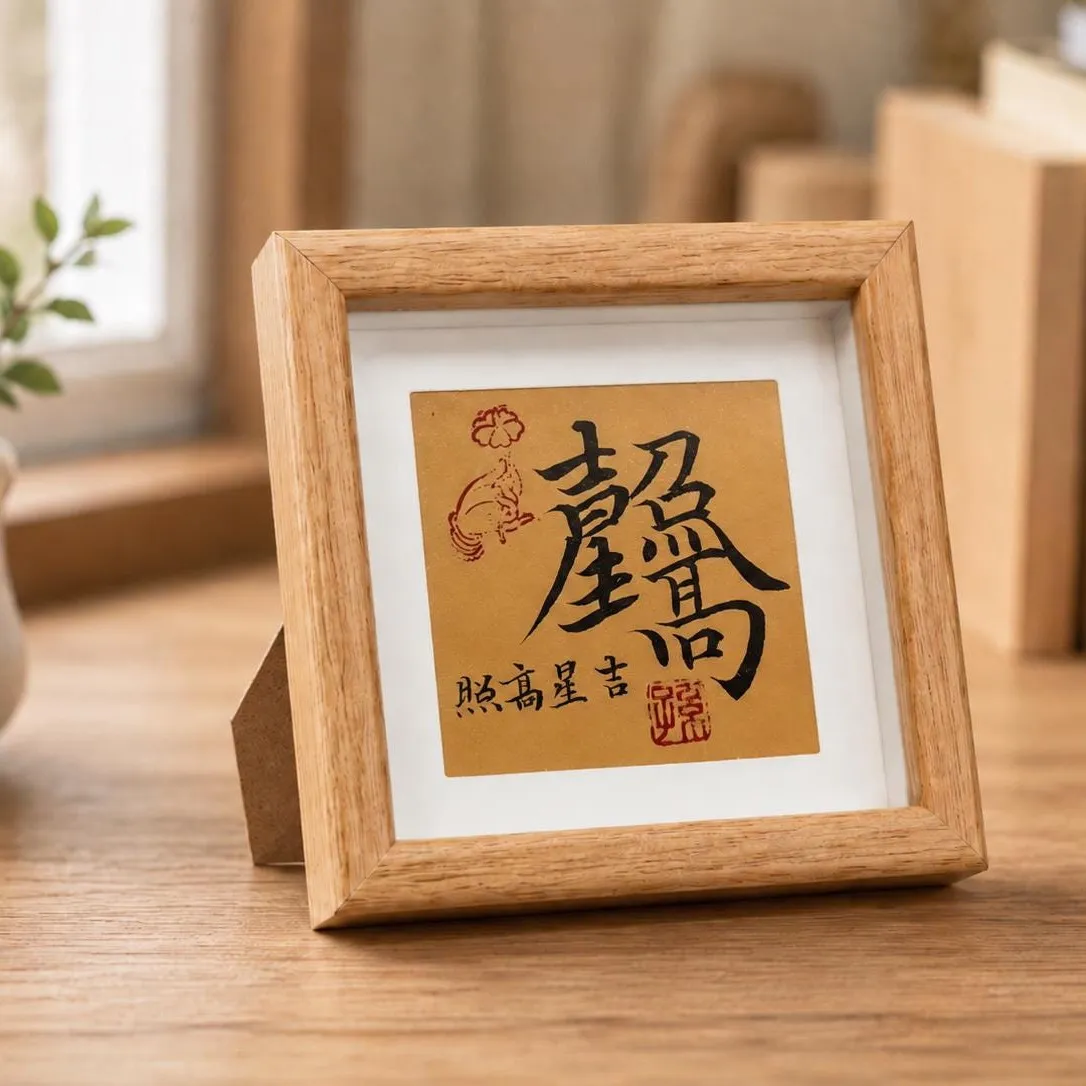
Photo shows a sample — yours will be brushed with the character you choose.
Desk Frame — for desks, studies & studiosfrom $44→